
This article was originally published in English on the It’sComplicated blog:
Imagine a tool that acts as a map to help you explore your emotional landscape: it helps you categorise, understand and experience your emotions, and guides you back to your true self. This tool is the Triangle of Change.
– Jack Kornfield
“If you can stay calm in the face of bad news; if you keep your cool even in the midst of a financial crisis; if you see your neighbours going on holiday to fantastic places without feeling the slightest twinge of envy; if you happily eat everything on your plate; if you can fall asleep after an exhausting day without alcohol or sleeping pills; if you always find contentment wherever you are – then you’re probably a dog.”
The Triangle of Change is your compass to help you find your way through the complexity of your feelings. It shows you where you currently stand in your emotional journey:
- that you withdraw into yourself to protect yourself from your feelings,
- whether you are held captive by paralysing emotions such as fear, shame or guilt
- or whether you are in touch with your core emotions – such as joy, anger, sadness, fear, disgust or excitement – which lead you to your true self.
The version of the Change Triangle® discussed here was introduced by the American psychotherapist and author Hilary Jacobs Hendel in her book *It’s Not Always Depression: A New Theory of Listening to Your Body, Discovering Core Emotions, and Reconnecting with Your Authentic Self* (2018). It is a simplified version of a clinical model derived from AEDP (Accelerated Experiential Dynamic Psychotherapy) – a psychotherapeutic approach developed over more than two decades by the psychologist and psychotherapist Diana Fosha and her institute in New York.
The benefits of the Change Triangle®
As a therapist and as a human being, I find this model very relevant, as it strikes me as profoundly human. It clearly shows that self-regulation does not mean indifference. By definition, we cannot spend our entire lives in a state of authentic self. We cannot escape chaos. As Kristin Neff says: we can only aspire to become benevolent chaos. What happens around us influences us. Life is constantly throwing things at us.
Self-regulation is a dynamic journey. It is not some untouchable state. On the contrary: self-regulation is the ability to stay connected to oneself amidst the discomfort caused by emotions – the ability to be present in what is intense, turbulent or chaotic. And it is also the ability to recognise when we need others to support us on this journey. Regulation is precisely this movement up or down within the triangle. Defence mechanisms also have a regulatory function, even if they come at a high cost in the long term. Calm, serenity and inner harmony can be the result of regulation.
The ability to identify where we stand on the triangle and to know how to move up or down between the three vertices and the four states helps us to manage our personal experiences. If I know where I stand, I can be depressed yet stable, I can be overwhelmed yet stable, I can be angry, excited, sad… and still stable.
The other benefits of this job are as follows:
- Gaining a better understanding of your feelings and making sense of them
- Being able to put our feelings into words the very moment we feel them
- Less fear of emotions, more presence and serenity
- Alleviate symptoms caused by repressed emotions such as fear and grief
- to have more control over your unconscious behavioural patterns
- Being able to feel our emotions makes us less reactive and less defensive
- Gaining a better understanding of oneself and others by looking beyond appearances
The ‘Change Triangle’: everything you need to know
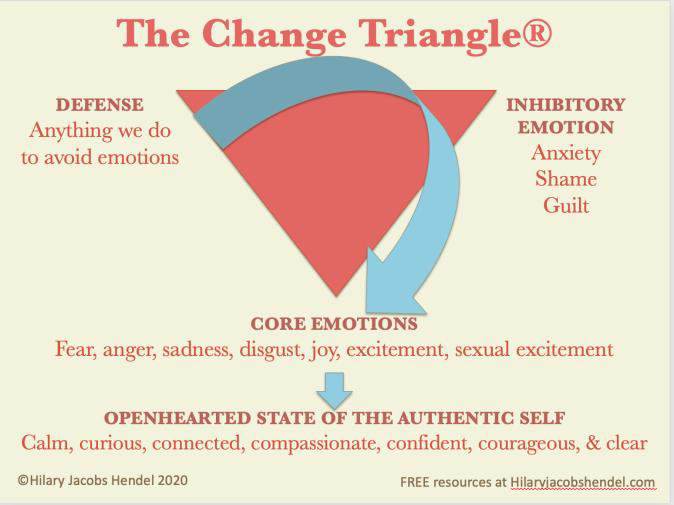
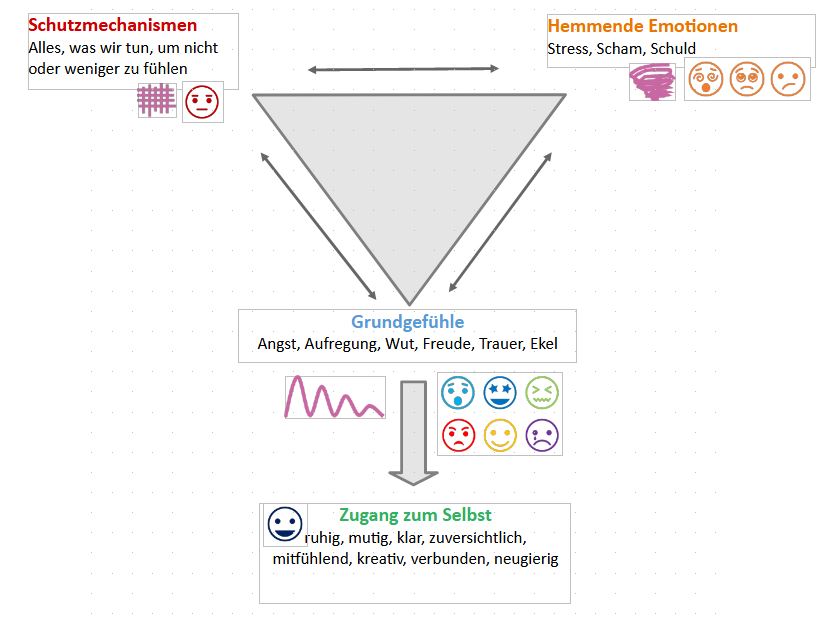
The Triangle of Change serves as a guide to identifying the defence mechanisms and inhibitory emotions that prevent us from connecting with our core feelings. Imagine it as an inverted triangle, pointing downwards. At each corner, moving clockwise – starting from the top left corner – you will find an emotional state: Defence (defence mechanisms), Inhibitory Emotions (inhibiting emotions) and Core Emotions (core emotions). Beneath the triangle lies the Openhearted State of the Authentic Self.
Everything we do to avoid feeling: defence mechanisms
Defence mechanisms are everything we do to avoid feeling certain emotions, or to dampen them. These can be thoughts or actions that distract us from the discomfort associated with these emotions. Common examples include negative thought patterns, distraction, consumption, sarcasm, depression, and so on. Sometimes we are aware of our defence mechanisms, sometimes we are not.
They range from healthy ways of coping to destructive habits. We need them to get on with life, but if we rely on them all the time, we lose touch with our feelings and with ourselves. Ideally, we use our defence mechanisms when we need them, but not all the time.
Suppressing one’s feelings: stress, shame and guilt
Inhibiting emotions include stress (anxiety), shame and guilt. These are intense physical states that can block our primary emotions. The pressure exerted on emotions as they rise to the surface causes great distress. Inhibiting emotions serve to protect us from being overwhelmed by primary emotions (stress) and to help us fit in with the group (shame, guilt).
We learn to recognise our feelings through our social experiences, especially as babies, children or teenagers. We learn which feelings are considered acceptable or unacceptable by those around us by observing the reactions of adults, and then those of our peers. And since our fundamental survival instinct is to stay connected to the people around us, a negative or positive reaction determines how we manage our feelings. For example, if, as a child, every time I was sad and cried, my parents told me to ‘think positively’, I learnt that sadness was not an acceptable feeling and that I would be better off not feeling or expressing it. Inhibitory feelings also come into play when basic emotions become too intense and our brain wants to switch them off to protect us from an emotional overload.
Inhibiting emotions arise when we are at odds with our core feelings: we believe we are bad when we feel them, that we will be rejected if we feel them, or simply that we do not know how to feel them. This is how stress, shame and guilt connect us to our environment, yet also cut us off from ourselves. They act as emotional stop signs that spring up to block the core feelings we have been taught to regard as unacceptable. They will reappear throughout our adult lives unless we actively try to change these patterns and seek out new experiences or relearn.
Our guiding principle: fundamental emotions
Basic emotions are hardwired into our brains (the limbic system) and are beyond our conscious control: sadness, fear, anger, joy, excitement, disgust and sexual arousal. It is through these basic emotions that we discover ourselves and what matters to us. They tell us what we need, what is good or bad for us, what we like and what we dislike. Their function is to enable us to adapt as best we can to our environment, and they are always accompanied by an impulse to act. For example, anger prompts us to set a boundary when someone has treated us in a way we do not like, and fear can alert us to the fact that a situation might be dangerous.
Each core emotion has its own energy and feels different. All core emotions exist on a spectrum and can range from mild to intense, or even overwhelming experiences. Our ability to feel and experience our emotions, as well as to ground ourselves emotionally, depends on how we were emotionally supported when we were young. We learn to self-regulate through our relationships with the people we grow up with. We need others to be able to regulate ourselves (co-regulation). Even as adults, we still need others to be able to experience and accept our feelings, even if society tells us otherwise.
Often, we haven’t been taught how to feel our emotions. Immersing oneself in a core emotion is like riding a wave. We feel the sensations rising within us and let them be, until they subside. Core emotions need to be felt fully and acknowledged. We need our body and our breath to stay grounded in this emotional experience and stay with these sensations until they reach their peak, then fade away like a wave. When we are able to work through a fundamental emotion, we often feel a sense of relief or clarity.
Being who we are: the self
The authenticity of our inner self refers to our very essence and the state we experience when we feel in tune with ourselves: calm, curious, connected, compassionate, confident, courageous, clear-headed and creative. This state sets in as soon as we have fully experienced our core emotions. In this state, we often have a clearer vision of how we wish to approach a situation. The situation may not be resolved, but the pain and unease, the pressure and urgency we felt have disappeared, and we can move forward from a place of calm. The seven adjectives (in English, the seven Cs: calm, curious, connected, compassionate, confident, courageous, clear – here supplemented by creative) are borrowed from the self-description derived from Richard Schwartz’s IFS (Internal Family Systems) therapy.
How do you use the ‘Change Triangle’?
The Triangle of Change is a bit like a map that shows us where we are in our journey at any given moment. We can learn to find our bearings on this map and look after ourselves, because we allow ourselves to feel what we’re feeling.
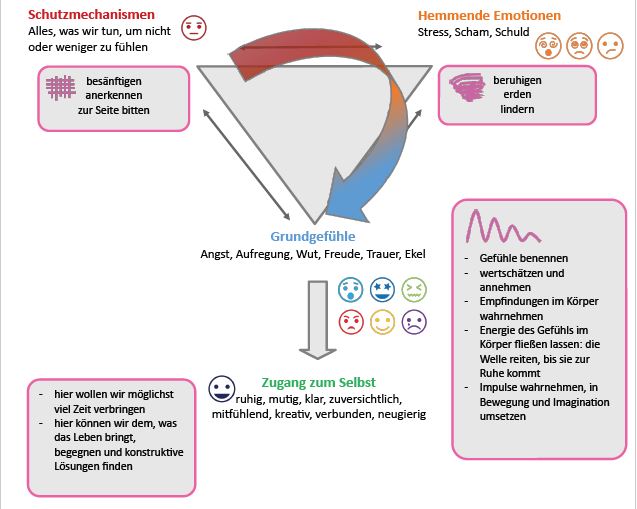
We can approach defensive attitudes with gratitude, compassion or respectful detachment; we can soothe and ease the feelings that are holding us back, so that the underlying conflicts, needs and core emotions can come to the surface. We can learn to feel these core emotions and their waves, and to stay in touch with them until they subside and we regain our calm. We are then reconnected with ourselves and have access to our inner resources. In this state, we can cope with whatever life throws at us and find constructive solutions for ourselves.
So, in practical terms, what can we do at the different points of the triangle of change?
weaken the body’s defences
When it comes to defence mechanisms, it is about recognising that we are protecting ourselves from emotional pain or discomfort. By becoming aware of our defence mechanisms, we can turn our attention inwards and ask ourselves: ‘What is going on inside me that I don’t want to feel right now? ’ Above all, it is about cultivating a compassionate attitude towards our defence mechanisms. It is understandable that we often simply want to get rid of them, as they are so unpleasant. But it is often not as simple or one-dimensional as that. Defence mechanisms do us a great service and only want what’s best for us. It is therefore important to develop an understanding of them, to recognise and value them, whilst learning and making possible other ways of managing our emotions.
Relieve stress, ease feelings of shame and guilt
In the section on inhibiting emotions, the aim is to become aware of the physical sensations that accompany stress (anxiety), guilt and shame. By focusing our attention on our bodies, we learn to soothe these unpleasant sensations, for example through mindful breathing, movement or mindful attention, so that the underlying blocked feelings can rise to the surface. Here again, the aim is to adopt a caring and compassionate attitude, and to understand the origin and workings of these feelings.
Learning to ride the waves of deep emotions
In the realm of core emotions, the aim is to perceive and experience the physical sensations associated with emotions. In this way, each emotion can become rooted in our physical experience. In a second step, we can acknowledge these emotions by naming them and allowing space to experience their ebb and flow. An emotion rises within us, then subsides. Within this movement, we also perceive the messages and impulses for action inherent in these emotions. Sometimes, we are unsure of what we are feeling; using the Triangle of Change, we can ‘try out’ different emotions by asking ourselves: am I feeling sad? Am I feeling anxious? Etc. Sometimes, we also feel several emotions at the same time. Experiencing these fundamental emotions ultimately reconnects us with our authentic self.
The embodied state of the authentic self
When we are in this state of openness to our authentic self, the important thing is to stay there for as long as possible and as often as possible. It is from this place that we can face life’s challenges with courage, curiosity, calm, clarity, compassion, confidence and a sense of belonging to ourselves and to the world. This is how we can deal with what is. Step by step. Our authentic self and its qualities are part of our very essence and are always there for us. We can learn to actively connect with them again and again, by making space for our feelings and for what moves us. This journey towards oneself is an art of living.
Summary
The Triangle of Change is not merely a theoretical concept that describes our emotional experiences and their transformative power, but also a practical tool that helps us navigate the complex landscape of our emotions in our daily lives. By familiarising ourselves with the vertices of the triangle, we learn to pay attention to our inner experience and to explore our defence mechanisms, our inhibiting feelings and our core feelings. This self-awareness and self-compassion lead us towards our authentic self, time and again, breath by breath and step by step.
Sources and references
Emotions Education 101™ is a registered trademark of Hilary Jacobs Hendel and Heather Sanford. Copyright Hilary Jacobs Hendel and Heather Sanford. All rights reserved. The Change Triangle® is a registered trademark of Hilary Jacobs Hendel and ‘It’s Not Always Depression©’ is a registered trademark of Change Triangle LLC.
Hilary Jacobs Hendel, It’s Not Always Depression: A New Way to Listen to Your Body, Understand Your Deepest Emotions and Reconnect with Your True Self, 2018
Hilary Jacobs Hendel also offers a wealth of resources on the ‘Change Triangle’ and emotions on her website HERE
Diana Fosha, The Transformative Power of Affect: A Model for Accelerated Change, 2000
Diana Fosha (ed.), Undoing Aloneness & the Transformation of Suffering into Flourishing: AEDP 2.0, 2021
To find out more about AEDP (Accelerated Experiential Dynamic Psychotherapy), click HERE
Richard C. Schwartz, Introduction to the Internal Family System, 2001
Leave a Reply