

Rethinking Trauma Through Response-Based-Practice
This article was first published in English on the It’s Complicated blog.
One of the most heartbreaking realities in therapeutic work is witnessing how deeply people blame themselves for violence, oppression or adversity they endured. Again and again, clients come to therapy believing they failed: I should have fought harder. I should have left sooner. I should not be so affected by this. Because violence continued despite their efforts, they often cannot recognize the countless ways they resisted/are resisting in order to preserve safety, dignity, sanity, relationships, or life itself. And too often, we as therapists unintentionally reinforce this self-blame. When we rely only on the language of symptoms, pathology, coping deficits, attachment wounds, or emotional dysregulation, we risk obscuring the violence itself and the intelligent responses people developed under coercive conditions.
Response-Based Practice offers another way of seeing. Rather than asking only What did the violence do to you?, it asks: What exactly did the perpetrator do, and how did you respond? This shift is not simply a compassionate reframe; it is an attempt to describe violence and responses to violence more accurately. Once violence is understood relationally and contextually, resistance becomes visible. And once resistance becomes visible, we can begin to honor with our clients the many ways they have struggled to protect themselves, others, and their dignity all along.
I asked you to stop
Source: Public Service Announcements, Whitehorse Yukon, Kanada
I tried to negotiate
I screamed for help
I turned my face away from yours
I crossed my legs
I stuck out my stomach
I clutched a tree
Then I went limp to avoid the pain
And went to a safe place in my head
Do you really question my resistance?
The judge decided I consented.
Nobody asked to be raped.
Stand with us for dignity and non-violence.
When Survival Looks Like Failure
“I’m such a coward,” she says, dropping into the chair in front of me, tired and exhausted. “I freeze when he floods my phone with messages about our child. I can’t keep up. I either respond for hours and end up exhausted, or I stop replying but I know he will use that against me in our next mediation session and I`ll be called uncooperative.”
Since the separation, her ex-partner has turned every exchange into a crisis: endless “concerns” about school lunches, pick-up times, doctor appointments, bedtime routines, holiday planning. Nothing ever gets resolved. Every message pulls her into circular arguments, accusations, and self-doubt. Professionals urge her to communicate better, stay calm, engage more collaboratively—without recognizing how coercive control hides behind the language of co-parenting. Sometimes things go quiet for a while. She starts to breathe again. Until he finds a new way to pull her back in.
Often when she comes to therapy, she is full of blame for herself: for shutting down, for people-pleasing, for feeling emotionally flooded all the time, for not being able to set a boundary, for being exhausted. But what if these are not signs of weakness or dysfunction? What if the very responses we call symptoms are actually intelligent, life-preserving acts of resistance? Response-Based Practice invites us to see violence differently: not only in terms of harm, but in terms of the countless ways people resist, protect their dignity, and survive. Understanding how coercion feels and honoring that resistance to it is where her healing begins.
The Language That Traps Us
“I’m such a coward. I froze when he yelled at me. I should’ve fought back.”
“I’m so broken. I smiled when they humiliated me. I should’ve said no.”
“It’s my fault. I agreed to have children with him. I should’ve already left.”
I could name endless variations of this kind of self-blame from people I am working with. A lot of them have been victims of physical or sexualized violence, assault, severe neglect, coercive control, stalking, workplace harassment and other forms of systemic or colonial oppression. They all have internalized that they are a problem and that if they would not be so broken those things would not happen to them or not impact on them as they do. When trauma is understood mainly through its neurobiological effects, the focus easily shifts toward what violence did to the victim rather than how the person responded to survive it. It also conceals that the deliberate choice to use violence or control against someone includes breaking their very resistance. Many clients are then left blaming themselves for not being able to simply “get over it.”
Linda Coates and Allan Wade distinguish four discursive operations that make this misrepresentation in the context of interpersonal, systemic or colonial violence possible. Here language is used to:
a) conceal violence,
b) mitigate perpetrator responsibility,
c) conceal resistance, and
d) blame victims.
In our example, this language becomes painfully visible in the way it erases agency and responsibility. It leads institutions and professional practices to participate in coercive control, even unintentionally, but precisely because they fail to recognize it. Practices framed as neutral—mediation, co-parenting communication requirements, expectations of “collaboration”—can become extensions of abuse when power, fear, and coercion are ignored.
- Concealing the Violence
The abuse is framed as a “high-conflict co-parenting dispute” rather than coercive control. His relentless messaging is described as “concerns about the children,” “communication difficulties,” or “poor boundaries,” which disguises the pattern of surveillance, intimidation, and domination underneath. Because violence is psychological and administrative rather than physical, it becomes normalized as ordinary post-separation conflict. The cumulative impact on the victim—hypervigilance, exhaustion, inability to think clearly—is rendered invisible and later pathologized. - Mitigating Perpetrator Responsibility
His behavior is interpreted in charitable terms: he is “trying to stay involved,” “anxious about the children,” or “struggling with the separation.” Professionals may encourage both parties to improve communication equally, implying mutual responsibility. The coercive pattern disappears into neutral language about “miscommunication” or “relationship breakdown.” Even the endless barrage of messages can be reframed as evidence that he is an “engaged father,” rather than someone feeling entitled to and strategically consuming her time, attention, and emotional energy. - Concealing Resistance
Her responses are often seen only as symptoms or deficits. Freezing, delayed replies, emotional shutdown, carefully worded messages, or limiting contact may be interpreted as avoidance, instability, or poor co-parenting. Yet from a Response-Based perspective, these are acts of resistance and self-protection. She may spend hours crafting neutral responses to avoid escalation, document interactions meticulously, silence notifications to preserve sleep, or strategically disengage from circular arguments. These are skilled, deliberate actions taken under conditions of coercion, but they are rarely recognized as resistance because they do not resemble dramatic confrontation. - Blaming the Victim
Once resistance is concealed, responsibility shifts onto her. If she replies emotionally, she is “reactive.” If she does not respond quickly enough, she is “uncooperative.” If she becomes exhausted or dysregulated, her distress itself is treated as evidence that she is the problem. Mediation processes can intensify this dynamic by assuming equal power and mutual capacity for negotiation. The focus moves from his coercive conduct to her communication style. She begins internalizing these judgments, asking herself: Why can’t I just handle this better? In this way, institutional discourse can reproduce the abuser’s narrative while appearing neutral and professional.
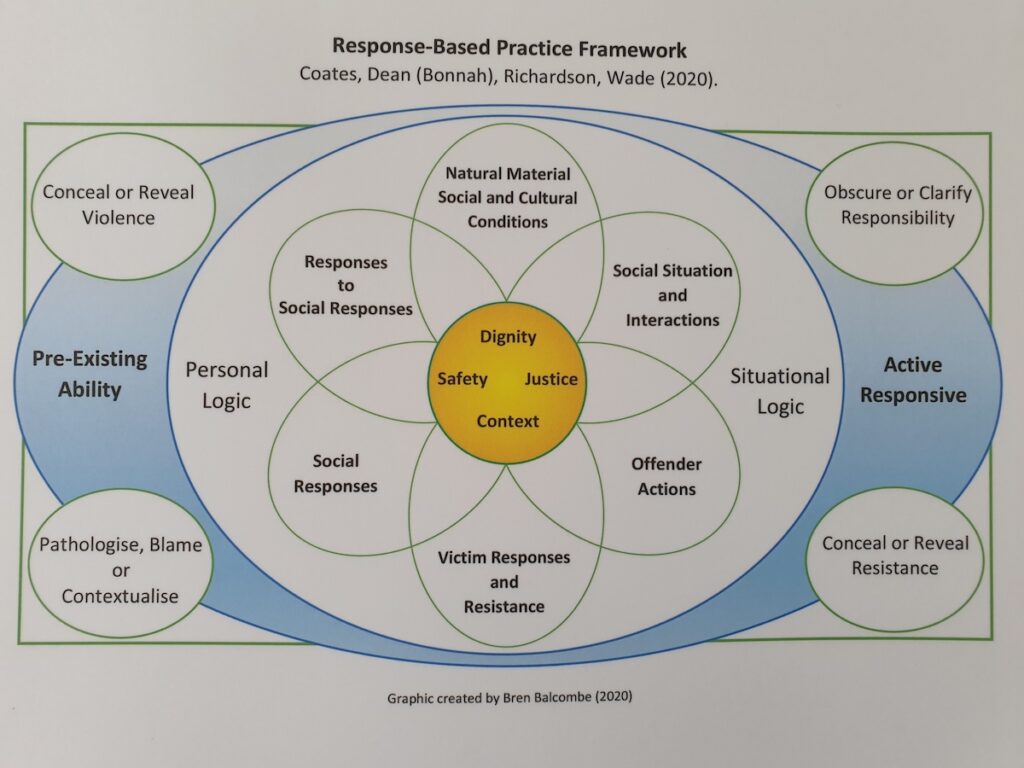
Response-Based Practice: Violence, Resistance, and Dignity
Response-Based Practice challenges these discursive operations by asking different questions: it moves from What’s wrong with you that this happens to you? to What exactly did he do? How did you respond? What values and dignity were present in those responses? How did/do you survive what is happening to you? The shift is subtle but profound. Instead of viewing her as passive, pathological, or failing, we begin to see a person actively responding to ongoing coercion while trying to protect herself and her child in a context that repeatedly undermines those efforts.
RBP operates through the following three assumptions:
- Violence is unilateral, social, non-consensual and deliberate: Violence is not a mutual “dynamic” or a loss of control, but an action imposed by one person against another’s will and wellbeing. Perpetrators anticipate resistance and often take deliberate steps to overcome, conceal, minimize, or punish it. Even so-called “explosive” or “out of control” acts of violence involve choices, strategies, and social awareness.
- Whenever people are subjected to violence, oppression, and adversity, they resist in some form: Individuals respond to and resist violence and other forms of injustice. Resistance can be open and direct or subtle and disguised depending on the situation. Open defiance is the least common form of resistance.
- Social responses are crucial: Victims and offenders are constantly mindful of actual and possible social network and institutional responses. The quality of social responses in cases of violence is closely tied to victim responses, offender strategies, and outcomes in the short and long term.
He rapes me at home
Source: Public Service Announcements, Whitehorse, Yukon, Kanada
I try to come home as late as I can
I try to never be alone at home
I try to always bring a friend
I work as many night shifts as I can
Hoping that he`ll be asleep when I come home
When all that fails, I get drunk, hoping I`ll pass out.
That is how I attempt to stop it.
Do you really question my resistance?
The judge decided I consented.
Nobody asked to be raped.
Stand with us for dignity and non-violence.
Where there is violence there is resistance
Perpetrators (and society) erase resistance to maintain control. Our role as therapists is to witness, name and honor the resistance clients don’t see in themselves. By describing moment-to-moment the victim’s response to the act of violence, their resistance is made visible. This is important regardless of whether their resistance stopped the violence or not. This process also includes carefully describing the broader context and the social responses surrounding the violence. Experiences of adversity are often misrepresented by negative social responses from others, this includes family and social networks and as well as from professionals, authorities and institutions. Only when resistance becomes visible, victims can begin to see themselves not as broken or complicit, but as people who have been actively and creatively struggling to preserve their dignity all along.
“Resistance is ubiquitous: Whenever individuals are subjected to violence, they resist. Alongside each history of violence, there runs a parallel history of resistance. Victims of violence face the threat of further violence, from mild censure to extreme brutality, for any act of open defiance. Consequently, open defiance is the least common form of resistance.” (Coates/Wade 2007).
Response-Based Practice understands resistance as “…any mental or behavioral act through which a person attempts to expose withstand, repel, stop, prevent, abstain from, strive against, impede, refuse to comply with, or oppose any form of violence or oppression including any type of disrespect), or the conditions that make such acts possible,…” (Wade 1997)
If we fail to ask the right questions, both the violence and the victim’s responses to it disappear from view. Let’s look at an account of sexualized assault where the victim is passive:
He followed her down the sidewalk. He sped up to catch her. He grabbed her by the shoulders and threw her to the ground. He dragged her toward the bushes. He overpowered her and dragged her into the bushes. He held a rock over her head and threatened to kill her if she screamed. He called her degrading names. He forced his mouth onto her face: He tried to undo her belt: He grabbed her pants legs to pull them off. He overpowered her and virginally raped her.
And now imagine what kind of questions would you need to ask to arrive to the following account of the same assault, where the victim’s resistance is made visible and named:
He followed her down the sidewalk. She sped up. He sped up to catch her. She moved to the side. He grabbed her by the shoulders and threw her to the ground. She rolled on the ground to get away. He dragged her toward the bushes. She grabbed the roots of a tree so he couldn’t drag her into the bushes. He overpowered her and dragged her into the bushes. She started to scream. He held a rock over her head and threatened to kill her if she screamed. She stopped screaming. He called her degrading names. She said: “You don`t want to do this. You don`t want to hurt me”. He forced his mouth onto her face. She averted her face. He tried to undo her belt. She stuck out her stomach so that he could not undo her belt. He grabbed her pants legs to pull them off. She crossed her ankles so that he could not pull off her pants. He overpowered her and virginally raped her. She went limp to avoid injury and went elsewhere in her mind.
Too often, we measure resistance by its effectiveness in stopping violence. Did she leave? Did she say no? Did she report it? Did she fight back? But this framework subtly shifts responsibility onto victims while exonerating perpetrators. It also casts doubt on victims’ resistance itself, leading them to question whether they were somehow complicit in the violence against them.
What if we’d ask instead: What did you notice just before you froze? What were you afraid would happen? Did you monitor the other person’s mood, movements, or tone? Did you try to avoid escalation? Did you leave later, seek help, tell someone, or change your behavior afterward? Often we help our clients discover that “I did nothing” was not literally true. They were perceiving, calculating, protecting, enduring, or minimizing harm. The point is not to force a positive identity. The point is to recover actions that disappeared from the original narrative.
And let’s be clear: It does not always take two to tango. The only person who can stop violence is the person who chooses to commit it. At the same time, institutions, social systems, and communities bear responsibility for creating conditions that make the choice of violence more or less possible, tolerated, or concealed. Resistance should therefore not be measured by whether it successfully ended the abuse, but by the countless ways victims preserve dignity, values, relationships, safety, and sense of self under conditions of violence and oppression.
Pathologizing victims’ responses may sometimes protect us, therapists—and society—from having to confront the unbearable reality that human beings can be rendered powerless by violence, coercion, discrimination, or structural injustice. It asks us to sit with our helplessness while holding our clients in theirs. Honoring resistance is not saying, people are always powerful or everyone always resists effectively. Rather, RBP asks: Even under conditions of severe powerlessness, what did you try to do? And the question for us as therapists is: Is helplessness allowed to exist in our practice? Can we tolerate witnessing experiences that cannot be redeemed? That can not be transformed into growth, not be reframed as resilience and not explained as dysregulation. But that simply remain unjust, horrifying, humiliating, tragic. And can we remain alongside our clients there?
Dignity is the moral compass of Response-Based Practice and stands as the opposite of violence. Violence—whether interpersonal, structural, colonial, or discursive—is not merely harmful behavior; it is an attack on dignity. It seeks not only to control people, but to define them.
In RBP dignity is not something victims passively possess or lose—it is enacted and preserved through resistance. This understanding fundamentally changes how we interpret human responses to violence. These responses are not random symptoms appearing inside individuals; they develop relationally as people attempt to preserve safety, connection, dignity, or bodily integrity under conditions they did not choose. Also, resistance does not require intention or awareness; it is defined by its function in relation to coercion. As therapists we need to understand that in this context:
- Freezing is a response to threat, not proof of trauma.
- Hypervigilance is a response to danger, not proof of pathology.
- Compliance is often a response to coercion, not proof of agreement, not even unconscious.
- Dissociation emerges in relation to overwhelming conditions, not proof of dysfunction or disorder.
Response-Based Practice is not about romanticizing suffering or redefining every response as strength. Nor is it simply a more compassionate interpretation of trauma. It is an attempt to describe violence more accurately. Once violence is understood relationally—who did what to whom, under what conditions, and how the victim responded—resistance becomes visible. What previously appeared as passivity, pathology, or dysfunction often reveals itself as intelligent, ethical, and strategic action under constraint.
Closing Thoughts: Honoring our clients Resistance in Every Day life
Violence-concealing language is everywhere.
So is resistance.
Part of our role as therapists, educators, friends, parents, and community members is learning to notice the small acts through which people preserve dignity every day—even when those acts do not look heroic, strong, or socially acceptable.
Sometimes “avoidance” is a person carefully monitoring danger before entering a room.
“People-pleasing” may reflect years of learning that disagreement leads to punishment or humiliation.
A nervous system described as “emotionally dysregulated” may be responding exactly as it learned to under chronic threat.
What appears as “non-compliance” may be someone protecting themselves from another degrading institutional experience.
And what is often described as “resistance to therapy” may, at times, be a wise resistance to being misunderstood once again.
Recognizing victim blaming means refusing explanations that individualize suffering while ignoring violence, oppression, and social context.
At its heart, Response-Based Practice is not only about analyzing violence differently—it is about seeing people differently. When we learn to notice resistance, we begin to recognize the intelligence, ethics, creativity, and dignity present even in the midst of oppression. Clients are no longer understood primarily through pathology, deficits, or damage, but through the countless ways they have struggled to preserve themselves and others under difficult conditions.
Honoring resistance changes therapeutic conversations. It changes institutional responses. And often, it changes how people see themselves. What once appeared as weakness, compliance, dysfunction, or failure can begin to be understood as courage, skill, care, and survival.
Journal Prompt: Recognizing Resistance
Think of a time you judged yourself for how you handled a difficult, abusive, or oppressive situation. Maybe you froze, stayed quiet, complied, shut down, dissociated, people-pleased, avoided conflict, or did whatever you needed to get through it.
Now ask yourself:
How might these responses have been forms of resistance?
Choose one specific incident. This could involve abuse directed toward you, someone else, or a situation of coercion, intimidation, humiliation, harassment, or injustice that you witnessed or experienced.
Write slowly and in detail.
· What exactly happened?
· What did the other person do?
· What did you do in response, moment by moment?
· What were you trying to protect?
· What thoughts went through your mind?
· What emotions did you feel?
· What did your facial expression, body posture, silence, compliance, or actions communicate?
· What did the other person do next?
· How did you respond again?
As you reflect, notice:
· What is it like to think about your responses as resistance rather than weakness or failure?
· Have your responses ever been labeled as “dysfunctional,” “dramatic,” “avoidant,” “too sensitive,” “non-compliant,” or “pathological”?
· How did those labels affect how you saw yourself?
· What becomes visible when you instead understand your responses in the context of what was happening to you?
Where there is violence, coercion, or oppression, there is often resistance — even when it is quiet, constrained, or unseen.
Sources and resources
Honoring Resistance. How Women Resist Abuse In Intimate Relationships
Choosing to Change. A Handbook for Men Concerned by Their Abusive Behaviors Against Those They Love
Jess Hill, See What You Made Me Do. Power, Control and Domestic Abuse, 2020
Nick Todd & Allan Wade, Coming to terms with violence and resistance: From a language of effects to a language of responses. In T. Strong & D. Pare (Eds.), Furthering talk: Advances in the discursive therapies. New York, NY: Kluwer Academic/Plenum, 2004
Allan Wade, Small Acts of Living: Everyday Resistance to Violence and Other Forms of Oppression. Contemporary Family Therapy, 19(1), 23-39, 1997
Linda Coates & Allan Wade, Language and violence: Analysis of four discursive operations. Journal of Family Violence, 22(7), 511-522, 2007
Domenica Feraud’s piece for the Medium blog, The Movie Star And Me (2022), offers a meticulous account of sexual harassment in its social context. Reading it with RBP lens we can see the victim’s resistance clearly. In addition, this article by Linda Coates, Shelly Bonnah, and Cathy Richardson — Beauty and the Beast: Misrepresentation and Social Responses in Fairytale Romance and Redemption. In C. Richardson & E. Fast (Eds). Life Matters. (2018) — provides a useful Response-Based framework for understanding violence and resistance as social responses more clearly.
Videos:
The Public Service Announcement are transcribed from Allan Wade’s presentation at Paccoa Australia
The two accounts of an assault are transcribed from Allan Wade’s webinar, Violence Resistance And The Power In Language_February 6, 2019
Masterclass Language and Violence with Linda Coates, 2018
The Trouble with Trauma Talk with Cathy Richardson, Allan Wade, Donny Riki, 2022
Upholding Dignity and Resistance: A Glimpse at Response-Based Practice with Cathy Richardson, 2024
German resources:
https://correctiv.org/aktuelles/haeusliche-gewalt/2023/09/19/die-netzwerke-der-vaeterrechtler/
Antje Joel, Prügel. Eine ganz gewöhnliche Geschichte häuslicher Gewalt, 2020
Leave a Reply