Category: Unkategorisiert

  • How to Keep the Conversation Going in Times of War

    How to Keep the Conversation Going in Times of War

    This article was first published in English on the It’s Complicated blog.

    “Real progress demands hard conversations. Real dialogue is messy, uncomfortable, unapologetic. And disagreement isn’t betrayal. Peace comes not from nodding in agreement, but from fighting through –  and for – our hardest truths” – Ahmed Fouad Alkhatib

     When Russia invaded Ukraine, I made a conscious choice to step back from the news. I remember that day in February 2022 vividly. Just as I was heading to work, my partner said, “It’s happening, there’s war.” I had a full day ahead, seeing seven clients, each grappling with their own emotional response to the war. I found myself asking each of them, “What have you done after receiving the news? How have you been resisting this violence today?” I framed resistance as the small, everyday acts we engage in to push back against violence, discrimination, and systems of oppression. Each client responded uniquely: making breakfast for their children to maintain a sense of normalcy, choosing a beautiful outfit to celebrate life, turning off the news to listen to music that connected them to our shared humanity, lighting a candle and offering a prayer, or openly allowing tears to flow. Each found their own form of resistance—offering comfort and strength.

    From one war to another

    At that time, it was easier for me to maintain emotional distance from the war, as I was less personally involved. I stayed away from the media, donated to humanitarian causes, and focused on my work, supporting my clients as they navigated their own fears and needs. But that changed after the horrific massacre of October 7th and the ongoing genocide in Gaza. This conflict felt closer, more personal, and something I already was involved in before because of family. I found myself caught in the midst of polarization from day one. Where could I take my pain, grief, anger, and despair? I was and still am outraged that German politics and civil society fail to create a space where both Palestinians and Israelis, Muslims and Jews feel seen, heard, and safe. In Berlin, home to large Palestinian and Jewish Israeli communities, neither group feels adequately supported.

    This failure deepens the polarization across our culture, media, schools, and public life, paving the way for dehumanization and isolation. The narrative became: if you’re for one, you’re against the other. Over the past year, I’ve witnessed relationships of all kinds breaking down—conversations cut off, people retreating into pain, despair, and shame, others lashing out in anger, or numbing themselves. The result is widespread polarization and disconnection. As a society, we’ve lost the ability to hold space for differing views and contradictions.

    How do we speak our truth and how do we listen to the truth of others during times of war?

    This is the challenge that Couples Therapy TV series therapist Orna Guralnik and her patient Christine explore in their conversation inThe Guardian Opinion from September. It’s a dialogue between a Palestinian and a Jewish Israeli about war, occupation, apartheid, genocide, terror and the deep power imbalances. Their conversation models how the communication strategies we use in intimate relationships can also help navigate difficult conversations with those we perceive as “enemies.” It’s a powerful example of trust building through self- and co-regulation.

    However, there’s a common misunderstanding about regulation. Many seem to believe that regulation means reaching a state where we no longer experience intense emotional responses, as though we can “fix” ourselves through enough healing or therapy. But regulation isn’t about avoiding intensity—it’s about creating enough inner security to take risks. It’s about staying grounded when everything inside us is shaking—whether from pain, anger, fear, or love. Regulation doesn’t always feel comfortable and a safe space is not necessarily a comfortable one. It’s the ability to hold multiple realities at once, remaining open to the world around us while staying connected to our own values and priorities, even when our hands are sweaty and our hearts are pounding.

    This practice of holding space for complexity is not only vital for our connection to ourselves and in personal relationships but also for the relationships between our communities. Nonviolent activists often describe liberation as the process of letting go of hatred and violence within, in order to engage constructively with those considered “enemies.” This commitment stems not just from solidarity, but also from self-interest: our own liberation is bound up with the liberation of others, our own safety is bound up with the safety of others.

    Empathy and Action: Building Accountability and Power

    Emotional resonance alone is not enough. Empathy requires us to be accountable and build power. True empathy is both emotional and cognitive—it’s about understanding another’s perspective and responding appropriately. Similarly, self-compassion isn’t just about being kind to ourselves; it requires fierceness—the strength to set boundaries, stand up for our values, and take action in ways that align with true self-care.

    In times of war, finding our voice and continuing to speak out when we can is crucial, especially when we have the resources and capacities to do so. We have a responsibility not to take sides, but to work toward solutions that uphold peace, nonviolence, and human rights. This means educating ourselves, listening deeply, and staying engaged—not to convince or even to agree, not to hold hands and become friends necessarily, but to hold on to our shared humanity and take steps toward a solution, one conversation at a time.

    4 Practical Steps to Engage in Difficult Conversations

    Whether it’s your best friend, partner, parent, or colleague, we all have relationships where disagreements run deep. Here’s how to approach these conversations constructively:

    1. Choose your battle: Are you in the right place to have this conversation? Do you have the capacity to engage? Prioritize self-care, and remember—you don’t have to fight every battle.

    2. Set yourself up to listen: Even if you disagree profoundly, focus on listening. While listening, use your body to stay open and grounded: breathe, relax into your chair, feel your feet on the floor, and let your triggers flow through you (=notice sensations and let them move through your body as you breathe).

    3. Find common ground: Try to understand where the other person is coming from and identify at least one small thing you can agree with and state it. Building trust starts with connection.

    4. Share your perspective: Once trust is established, clearly express what’s important to you. Stay respectful and polite. Remember, it’s not about changing the other person; it’s about speaking your truth.

    If the conversation becomes triggering again, revisit Step 1. And remember, it’s always okay to end the conversation if needed—protect yourself, and remain polite, even in disagreement.

    Hanging in there

    Having difficult conversations is hard, and it’s important to remember that these exchanges are part of a larger journey toward understanding and healing. Every conversation, whether it ends in agreement or not, is an opportunity to practice empathy, maintain connection, and stay grounded in our shared humanity. In times of war and division, the simple act of keeping the dialogue open is a form of resistance to violence and polarization. Those conversations can also be part of practicing hope as a skill. Sometimes we listen and hear someone say the words that we have been looking for, sometimes we speak and others might hear the words they haven’t found yet. Even when conversations feel incomplete, they are steps toward a future where mutual respect and peace are possible. Keep listening, keep speaking up, and keep working toward a world where every voice is heard and valued!

    From Pain to Liberation: overcoming internalized oppression

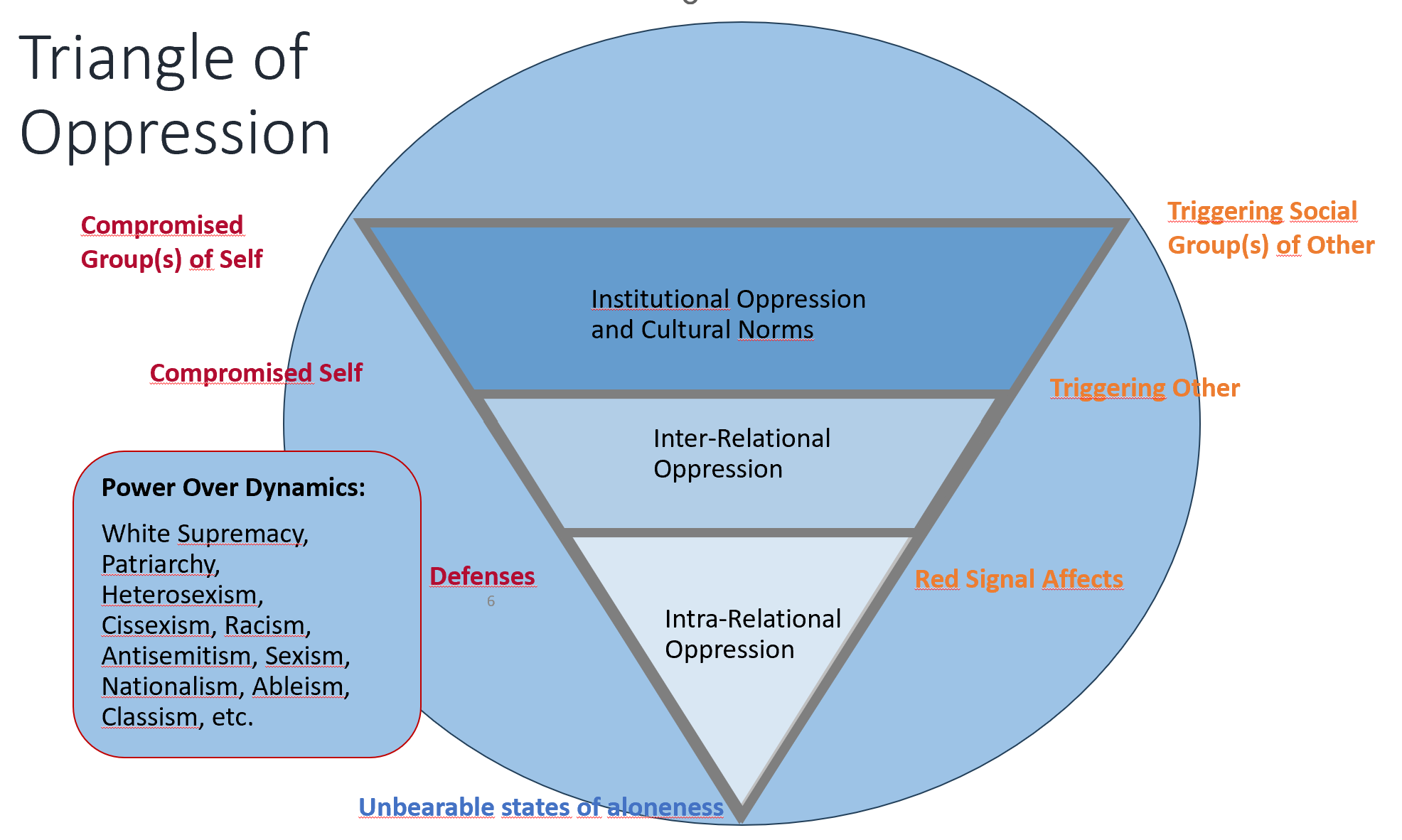
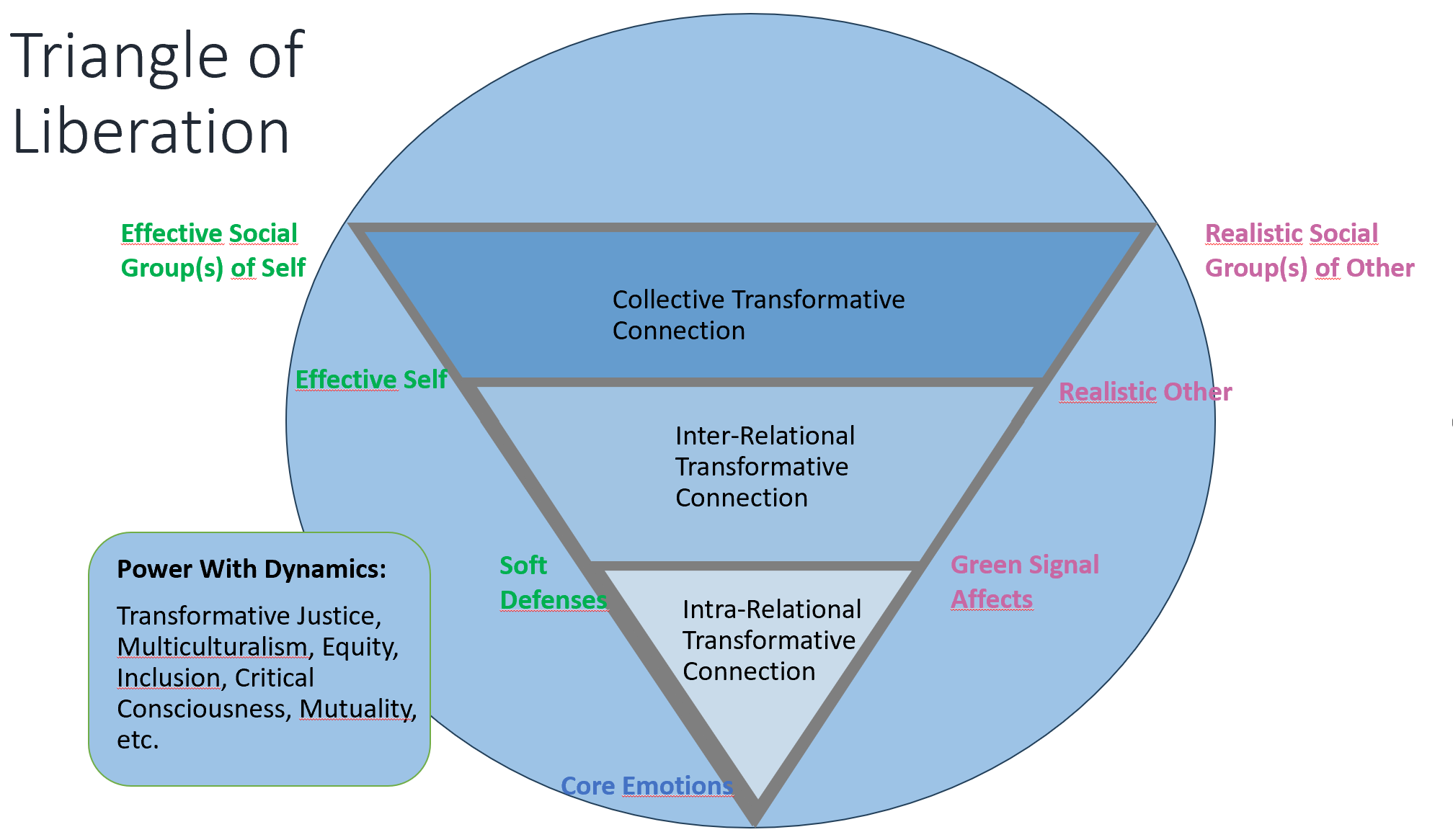
    The Triangle of Oppression and the Triangle of Liberation, as formulated by AEDP therapist Ben Medley, offer a framework for understanding societal transformation.

    The Triangle of Oppression outlines three forces that sustain oppression: dehumanization, disempowerment, and disconnection. These forces create a cycle that maintains inequality, injustice, and suffering in our societies. It is held within a circle of dynamics of oppression.


    In contrast, the Triangle of Liberation emphasizes the elements necessary for positive change: humanization, empowerment, and connection. To transform oppression, we need to see the humanity in others, empower individuals and communities, and foster deep, authentic connections. By addressing these three pillars, we can move toward a more just, inclusive, and compassionate society. It is held in a circle of dynamics of participation.


    Ben Medley’s framework guides therapists in fostering both personal and societal change. By helping clients reconnect with their humanity, reclaim their power, and build meaningful connections, therapists can counter the effects of oppression. This approach promotes individual healing and contributes to broader societal transformation.

    The circle enclosing both triangles signifies the concrete political context that influences how people perceive themselves and others—whether through oppressive or liberatory lenses. To cultivate liberation, we need effective political systems.

    If you want to learn more about the Change Triangle on an individual, intra-relational level, read our post on How to Understand and Navigate Your Emotions or visit our course SOS Emotions – Self-regulation with the Change Triangle.

    Sources and Resources:

  • How to Apologise: Rupture and Repair in Relationships

    How to Apologise: Rupture and Repair in Relationships

    This article was first published in English on the It’s Complicated blog.

    Read on for a therapist’s take on how to apologise effectively in relationships.

    Take a moment to think of the relationships in your life where you feel secure, meaning where you feel safe, seen, calm and soothed. What is it about these relationships that makes you feel comfortable and protected in them? Describe three interactions that create security and ease for you with this person. What did you discover?

    Attachment theory suggests that good enough, meaning healthy, relationships consist of 30% attunement and 70% rupture and repair. According to those figures it seems very human to spend a significant amount of time in a good relationship with repairing the ruptures and conflicts that naturally occur.

    Only a third of the time are we “in tune” with the other person, meaning emotionally responsive and connected, providing support, validation and understanding for the relationship to feel safe and comfortable.

    This perspective may be surprising at first, but it sheds light on how vital conflicts and their resolution are in building secure relationships. Some are afraid it dangerously gives license for bad behaviour. I find it hopeful, because we all (know how to) mess up.

    Since conflict will happen anyway, let’s focus on repair – which makes all the difference! In this post, we’ll explore what rupture and repair mean and the importance of how to apologise genuinely.

    Repair in relationships is about recognising when there’s been a rupture, demonstrating empathy and accountability, and taking steps to heal and rebuild trust and connection with the other person.

    What Is Rupture?

    Rupture signifies the moments when there’s a disconnect, tension, or conflict in a relationship. This can range from disagreements to misunderstandings to hurtful words and unmet expectations. Ruptures are normal in any relationship. It’s how we handle them that matters and that makes all the difference.  

    What Is Repair?

    Repairing means fixing and healing the cracks in a relationship. It’s the crucial step in rebuilding trust and emotional connection. Consistent repair is what makes us feel secure in relationships. When there’s too much rupture without enough repair we get distant and start to lose connection.

    Many of us might have grown up in environments where ruptures were mostly ignored, and repair was either absent or all about the other person feeling better. Yet it’s rarely too late for repair. Even after years, it can make a significant difference for the person who was hurt. When therapy works well, it helps to provide the repair that was missing that allows a person to heal. 

    Genuine repair aims to give the hurt person the sense of being safe, seen, soothed, and secure once again.

    What Repair In Relationships Looks Like:

    1. Apologising: “I’m sorry that I …” Acknowledge the rupture and take responsibility for what you did wrong that caused harm.
    2. Expressing regret: “I’m sorry this happened.” Acknowledge the rupture and express genuine sadness about what happened when you don’t need to own up to wrongdoing. 
    3. Truly listening to each other and making space for hurt feelings: Repair is about feeling heard and understood again. No quick fixes, no trying to get another person to see it your way, and no defending your viewpoint. 
    4. Getting the relationship back on track: Repair can happen quickly and implicitly e.g. engaging in an activity that fosters connection, making the other person feel cared for and seen.
    5. Small acts of repair: Leaving a note, writing a text, making eye contact to convey understanding, providing soothing physical gestures that comfort the other person.
    6. Making amends: Taking explicit responsibility, accountability and actions to work towards what is needed for the person who got hurt to feel safe, seen, soothed and secure again.

    In essence, repair in relationships is about recognising when there’s been a rupture, demonstrating empathy and accountability, and taking steps to heal and rebuild trust and connection with the other person. 

    Remember: Don’t promise it will never happen again. Stress responses are most likely to happen again. What you can commit to is working as hard as you can to reduce frequency and intensity of those reactions.

    Why (Self-)Compassion Is Mandatory In The Rupture-Repair Process

    Under enough stress we all lose our balance and have a point of no return where we show up with behaviours that are “mean, weak or gone”, meaning excessively harsh, ineffective or psychologically absent.  It’s human. Committing to (self-)compassion and understanding in those moments is not excusing those behaviours. The more we are criticised or the more we criticise ourselves, the more likely it is that we stay defensive and either ignore the rupture and don’t engage in the repair process, or we make the repair all about ourselves and not about the one who got hurt. 

    Receiving compassion (as well as boundaries!) from others when we are “mean, weak or gone” supports us in reconnecting with ourselves. Self-compassion also makes it more likely that we engage in repair with ourselves when we fall into stress and out of connection. This may include the decision to get help from a therapist or counsellor. And, last but not least, compassion is always a good idea when we need to get vulnerable.

    How To Apologise After A Relationship Rupture

    Apologies are sometimes challenging. They might make us feel vulnerable or busy with appearing weak. Yet we all know how needed an apology sometimes is. We’ve all had experiences where it didn’t happen and have experienced what a change it made when it did happen. Engaging in repair and apologising deepens our connection in relationships. So what should a good apology look like and what should be avoided when practicing how to apologise? 

    What Constitutes A Genuine Apology:

    • Acknowledging and naming the wrong: A sincere apology begins with an acknowledgment of what you did wrong. It involves openly admitting your mistake without reservation.
    • Demonstrating empathy: Expressing genuine empathy is crucial. Show that you understand how your actions or words affected the other person emotionally and possibly even physically.
    • Expressing the desire to make amends: A good apology includes a clear expression of your commitment to making things right. It involves asking the affected party how you can compensate for your actions or words, demonstrating your willingness to take action.

    Actions To Avoid In An Apology

    • Accusations: Do not include accusations or blame directed at the person you are apologising to. Phrases like “I’m sorry, but…” have no place in a sincere apology. Blaming others sidesteps accountability for your actions.
    • Self-Blame: While taking responsibility is essential, excessively blaming yourself can overshadow the person you hurt. An apology should focus on acknowledging the harm you caused rather than on your own guilt.
    • Demanding an apology in return: A true apology should not be followed by an immediate demand for an apology in return. Such demands shift the focus away from your apology and come across as insincere.

    In summary, rupture and repair are integral components of healthy relationships. It’s not the absence of conflict that defines a strong attachment but rather the ability to navigate and resolve ruptures effectively. A sincere apology is a powerful tool in the repair process; it demonstrates empathy, accountability, and a commitment to healing the relationship. By getting curious, understanding and embracing the importance of repair, we can foster secure attachments and restore loving connections.

    Journal Prompt:

    Recall a moment when you needed to receive a sincere apology that never came. Don’t go into the reasons why it didn’t come, write down the factual events of that situation. Describe your emotions and physical sensations you experienced during that moment.

    Afterwards, take a deep breath and, using the guidelines for a “genuine apology” mentioned above, write the apology you needed to receive. Pay attention to the physical sensations that arise as you engage in both the act of writing and envisioning the reception of this sincere apology.


    Sources and Resources:

    Ed Tronick, Claudia M. Gold, The power of discord. Why the ups and downs of relationships are the secret to building intimacy, resilience, and trust, 2021

    Harriet Lerner, Why Won’t You Apologize? Healing Big Betrayals and Everyday Hurts, 2017

    Hilary Jacobs Hendel, It’s not always depression. A New Theory of Listening to Your Body, Discovering Core Emotions and Reconnecting with Your Authentic Self, 2018

    If you want to dive deeper and get to know more tools for effective repair conversations, try this practice from the Gottman Institute: Aftermath of a Fight Guide

    Sometimes it is hard to show up with 30% of attunement. If you need support deepening connection and intimacy, try this practice from the Gottman Institute: Fondness & Admiration Guide

    To dive deeper into saying sorry, listen to this two-part podcast series by Harriet Lerner / Brené Brown, I’m sorry. How to Apologize and Why It Matters

    A lot information and practice about attachment theory is made available in parenting resources:

    Robyn Gobbel The Baffling Behavior Show

    Eran Katz The Apparently Parent Podcast

    Daniel J. Siegel on the four “S” of creating secure attachment as in “Safe, Seen, Soothed and Secure”

    The Circle of Security on rupture caused by “Mean, Weak, Gone” when we get defensive in relationships.

  • How to Get the Most Out of AEDP Therapy

    How to Get the Most Out of AEDP Therapy

    There are many approaches to psychotherapy, each with its own methods and strengths. AEDP (Accelerated Experiential Dynamic Psychotherapy) is a model that focuses on helping people transform suffering into resilience and vitality, not just through insight or coping strategies, but by experiencing emotions deeply and safely within a healing relationship.

    Therapy in AEDP can be profoundly rewarding, but like every important endeavor, it requires openness, courage, and intention. The more present you are in sessions—and the more space you create for reflection and integration between them—the more you’ll benefit.

    Below are some ways to help you get the most out of your AEDP journey.

    Intention: Coming With a Willing Heart

    In AEDP, the core intention is not only to “feel better,” but to feel more fully—to contact emotions you may have avoided, and to discover the vitality and compassion that lie beneath them.

    Therapy can sometimes feel intense or even overwhelming. At times, you may feel like nothing is changing, or that you’re revisiting old pain. In those moments, remembering your intention to heal and grow is crucial.

    AEDP holds that within each of us is a natural drive toward growth, connection, and transformation. When you bring the intention to lean into this process, even when it feels uncertain, you support your own capacity to heal.

    Questions to reflect on:

    • What do I most long for in this therapy?
    • Am I willing to let myself feel more deeply than I usually allow?
    • What would it mean to grow a more compassionate relationship with myself?

    Stuckness and Resistance: Meeting Them With Compassion

    Most of us come to therapy because we’re stuck—caught in patterns of thought, emotion, or behavior that feel hard to change. In AEDP, resistance is not seen as a flaw, but as a protective strategy that once offered the solution to a problem. It’s a part of you that has been trying to keep you safe.

    But those protective patterns can also block access to your deeper feelings, longings and strength. In AEDP, the therapeutic relationship offers a safe place to slowly lower these defenses, allowing your emotions to be felt, expressed, and metabolized in new ways.

    Protective strategies might look like:

    • Avoiding certain topics in session.
    • Feeling disconnected or numb just as you get close to an important feeling.
    • Wanting to change the subject when emotions rise.
    • Minimizing what you’re experiencing.

    Instead of judging these patterns, try to notice them with curiosity. Sharing them openly with your therapist often creates an opening for transformation.

    Questions to reflect on:

    • What parts of me tend to pull back when things get vulnerable?
    • What emotions do I find hardest to feel?
    • How do I protect myself from pain—and what might I lose when I do?

    Before a Session: Preparing to Drop In

    The best preparation for an AEDP session is cultivating a mindset of openness and willingness to feel. Unlike approaches that emphasize planning or problem-solving, AEDP works best when you allow space for whatever emotions, sensations, or memories want to emerge.

    • Take a few quiet minutes before your session to check in with your body. Where do you feel tension, heaviness, or aliveness?
    • Notice what feelings have been most present this week. Don’t overanalyze—just acknowledge them.
    • If you’ve kept a journal of dreams, images, or meaningful moments, bring it with you.

    During the Session: Allowing, Feeling, Sharing

    AEDP sessions are often deep and emotionally charged. That’s not a sign something’s wrong—it’s the heart of the work. Healing happens when emotions are experienced fully, in the presence of a supportive other.

    • Let yourself feel. Instead of talking about feelings, see if you can pause and notice what they’re like in your body.
    • Share your inner experience. Your therapist isn’t just listening to your story; they’re attuning to your moment-to-moment feelings. Try saying what you’re sensing, even if it feels raw or unclear.
    • Use the relationship. If you feel misunderstood, comforted, or even annoyed by your therapist, name it. In AEDP, the therapy relationship itself is a powerful space for healing.
    • Stay curious. Sometimes emotions come in waves—tears turn into relief, fear into strength. Trust that the process of transformation often unfolds in layers.

    Between Sessions: Integrating the Work

    Much of AEDP’s impact continues after the session ends. Once emotions have been processed in a healing way, the nervous system begins to reorganize. You may notice new clarity, compassion, or energy emerging.

    To support this integration:

    • Journal or voice-record your reflections after sessions. Capture moments of transformation or relief.
    • Pay attention to shifts in your body—new ease in breathing, less tension, a sense of calm.
    • Practice self-compassion: speak to yourself with the same kindness your therapist offers.
    • Notice when old patterns reappear, and instead of criticizing yourself, see if you can respond with curiosity.

    Final Thoughts

    Getting the most out of AEDP therapy means approaching the process with openness, courage, and compassion. Be willing to feel, to share vulnerably, and to let your therapist accompany you into the depths of your emotions. Transformation often happens in small, unexpected moments—through tears, a felt sense of relief, or the experience of being deeply seen.

    Above all, remember: AEDP is not just about reducing symptoms. It’s about uncovering your innate capacity for healing, connection, and joy.

    Resources:

    Tori Olds, What is AEDP? | Accelerated Experiential Dynamic Psychotherapy – PART 1

    Tori Olds, What is AEDP? | Accelerated Experiential Dynamic Psychotherapy – PART 2

    Tori Olds, What is AEDP? | Accelerated Experiential Dynamic Psychotherapy – PART 3

    Diana Fosha, AEDP Therapy: Engaging with Emotions & Experiences

  • Why and how should you listen to your body?

    Why and how should you listen to your body?

    This text was originally published in English on the It’s Complicated blog.


    “The body possesses its own non-conceptual intelligence, which is so often overlooked or undervalued in the face of cognitive intelligence. The body knows when it is hungry, when it needs to move, and what it needs to thrive. It conveys wisdom that comes from the feeling and experience of the present moment. When we lose touch with the body, we lose our connection to truths that disembodied cognition alone cannot access.”

    Willa Blith Baker


    Understanding and listening to our own bodies is crucial for a healthy life – a life that is present and grounded in our individual experiences, in our relationships, and in our existence on this planet. Amidst the stresses of daily life, challenging situations, life transitions and moments of crisis, we often feel disconnected from our emotions and become sceptical of physical symptoms. We spend most of our time in our minds and try to steer our lives from there.

    When we listen to our bodies, we can (re)connect with our vitality and (re)discover it, which leads to greater stability and a zest for life, whilst reducing anxiety, depression and exhaustion. It enables us to anchor our experiences in physical sensations, strengthen our connection to who we are, and create a secure foundation we can rely on in difficult times and situations.

    Body, Mind and Soul


    As human beings, we are both body and mind. Our culture gives priority to the mind and intellect over the body, and places cognition above perception and somatic awareness. Yet it is only by feeling our bodies that we come alive and perceive the world around us. Everything we experience unfolds within our bodies. The mental and the physical are always inextricably linked. Emotions, actions and thoughts are all specific processes that take place within our bodies. When we learn to make sense of our bodily experience, we can feel at home in our bodies and in our lives.

    We have all learnt not to listen to our bodies. We are used to listening primarily to our thoughts, so that we are ‘in our heads’ and have little sense of what is happening below our necks. Our mind often convinces us that something else is more important. Or what our body is telling us simply doesn’t fit in with our plans. Or we have an idea of what we ought to be experiencing, regardless of whether it has anything to do with what we are actually experiencing. We don’t want to be ill. We put off going to sleep when we’re tired, ignore our thirst and don’t breathe as deeply as we need to when we’re feeling intense emotions. We push on when we actually need a break. We shut ourselves off and isolate ourselves when we actually need a chat with a good friend. Listening properly takes a bit of practice!


    Listening to your body means learning:

    • to ground ourselves more firmly in the here and now, to lose ourselves less in the future or get stuck in the past. Physical awareness, feeling and thinking enable us to recognise what our truth is in a given moment, regardless of what our mind has to say about it. We cannot simply think that we are grounded; we must feel it in our bodies.
    • Finding the words to describe your experiences and feelings in physical terms. This exercise transforms overwhelming experiences into a somatic process. Instead of getting lost in an incomprehensible emotional state, you learn to pay attention to physical sensations such as a tense neck, shallow breathing, tense shoulders and a tight stomach. This step alone often reduces the intensity of overwhelming feelings. It also enables you to speak more precisely about your experiences, feelings and needs.
    • Feeling your feelings – be present with them and experience their energy and the waves of sensations they create in your body, without reacting to them automatically. We cannot think our way through an emotion; we have to feel our feelings. This step builds trust, as it enables you to stay with yourself and support yourself even in the midst of chaotic emotions.
    • Discover the deeper dimensions of your emotional experience. In everyday life, we often only have access to certain aspects of our emotional world. Through the body, we gain access to more facets of an experience and develop a deep sense of our intuition, enabling us to understand its impact on our actions and our lives.
    • Not being at the mercy of your feelings and experiences. Realising that feelings are a series of physical sensations makes it clear that they are involuntary AND that we can influence them. You can tense up or relax, hold your breath or keep breathing, tense or relax your muscles, stand still or move – and just like that, something can change.


    How to listen to your body


    Listening to your own body is often counterintuitive. We usually try to avoid unpleasant sensations – or simply intense sensations – and steer clear of experiences we don’t like. Listening to your body means turning your attention to precisely these experiences and the physical sensations they trigger, staying with them and approaching them with curiosity.


    Listening to your own body does not mean doing more yoga or exercise, eating better or going for a daily walk. It is not a tool; it is a principle. It is a state in which we tune into our sensations and feelings – a state in which we allow our body to teach our mind. It is an ongoing, lifelong practice that permeates everything we do. Listening to the body changes and deepens over time, as you change and your life experience deepens.


    Listening to your body means being attuned to its unique language: your sensations. To be able to listen, we need to ‘shut up’, turn down the volume of our constant stream of thoughts; we need to slow down and pay attention to the experience within and through our bodies, letting go of our thinking mind and sinking into our sensing, feeling body. Many people find it helpful to focus on their breathing to connect with their somatic experience. Others need movement or touch to better recognise what they are sensing in their body.

    Some people don’t feel confident enough to listen to their bodies


    If your body has stored traumatic experiences, if you are in the midst of coming to terms with a profound loss, in moments of crisis, or if you are plagued by severe anxiety symptoms or chronic pain, it can be a challenge to listen to your body and actually feel safe. Body psychotherapy, somatic coaching, trauma-sensitive bodywork and other embodiment practices can help you, with support, reconnect with your body, understand its signals and build trust in its sensations and movements, which our minds often cannot comprehend. Seek help if you need it!


    Even if you have a health condition, it can be a challenge to listen to your body. HERE is a lovely conversation from the On Being podcast about how to listen to your body when it is paralysed.


    Summary


    Listening to one’s own body allows for greater flexibility, as it broadens the scope for action in the face of intense experiences. It is about the ability to consciously replace a reaction of withdrawal with one of openness. This is not always easy, nor is it always possible. It is a practice and an art.

    Constant withdrawal, over time, creates a state of physical weakness and instability. A constricted body narrows our perception and our thinking. Opening up to sensations fosters sensitivity, strength and compassion. A receptive body promotes open perception and creative thinking. From there, we are best placed to decide what our next steps should be.

    ————-
    Sources and resources

    Paul Linden, Embodied Peacemaking: Body Awareness, Self-Regulation and Conflict Resolution, 2007

    Hilary Jacobs Hendel, *It’s Not Always Depression: A New Theory of Listening to Your Body, Discovering Core Emotions and Reconnecting with Your Authentic Self*, 2018

    Bessel van der Kolk, *The Body Keeps the Score: Mind, Brain and Body in the Transformation of Trauma*, 2014

    Steve Haines, Touch is really strange, 2021

    Willa Blyth Baker, *The Science of Embodiment: Connect to Your Body’s Wisdom*, 2023

  • The emotion regulation playlist: Using music to change your mood

    The emotion regulation playlist: Using music to change your mood


    I’ve always loved moving to music. For many of us, it comes naturally – music moves us, whether physically or emotionally. But for me, it wasn’t always easy. For years I struggled with my body image and felt ‘out of place’ in jazz dance classes (I always went left when everyone else went right!), which led me to give up dancing altogether. The same thing happened with singing: I used to love it, but after a friend told me, ‘You’re humming’, I stopped.

    It wasn’t until my mid-thirties that I began to rediscover music and movement for myself. A major part of this was down to singing lessons with the wonderful Veronika Böhle and training in ‘Stopping Movement’ with Anna Krimerman, Emily Poel and Merav Gur Arie – a practice in which you establish a simple ‘framework’ for each song:

    • which parts of the body you will be moving,
    • at what speed (slow/medium/fast),
    • and in what size (small/medium/large).


    It can be as simple as “move your arms and legs, at a moderate pace, with large movements” – or as quirky as “move your left eye, your right hip, your knees and your left toes, quickly and in small movements”. This playful exercise helped me regain my body awareness, my concentration and my sense of freedom.
    Nowadays, I often share a special tool with my clients: the emotion regulation playlist.

    Riding the waves: The playlist

    Music has a unique way of shaping our inner world. It can bring back forgotten memories, deepen emotions and change how we feel in the moment. But when we’re feeling overwhelmed or down, it’s not always easy to choose the ‘right’ song. Sometimes a cheerful tune can even make us feel worse.
    That’s why creating a playlist for emotional regulation is so effective: rather than forcing a mood, the playlist helps you ride the waves of emotion – whether that means crying, letting go of anger, feeling joy, or simply reminding yourself what it feels like to be human.

    What is an emotion regulation playlist?

    An emotional regulation playlist is a sequence of songs designed to provide you with emotional support. You start with music that reflects your current state – whether it’s sadness, restlessness or anger – and then gradually move on to songs that help you find balance, calm or vitality.
    Think of it as a bridge: You don’t have to jump from despair to joy in a single track. The music acknowledges where you are right now, and then gently guides you, step by step, to where you’d like to be.
    And you don’t just have to sit there and listen – movement can deepen the effect. Music plus movement can release tension, break repetitive patterns and create space for new states of being.

    How AEDP shapes the playlist

    From the perspective of AEDP (Accelerated Experiential Dynamic Psychotherapy), emotional regulation is not about ‘getting rid of’ difficult feelings. It is about treating yourself with compassion and allowing emotions to transform.
    Here’s how you can put together your playlist with this in mind:
    1. Start with radical acceptance
    ◦ Choose songs that match your current feelings. Are you heartbroken? Start with longing or grief.
    ◦ Pay attention to what is happening in your body – tightness in the chest, heaviness in the stomach, restless legs. Try moving gently to the music; simply follow your body without judgement.
    2. Allow for emotional depth
    ◦ As you listen, notice whether emotions intensify – more sadness, anger or letting go. AEDP reminds us that fully experiencing emotions opens the door to healing.
    ◦ Move to the music: let your body find freedom, vitality, flexibility or grounding – beat by beat.
    3. Move towards transformation
    ◦ Gradually add songs that convey hope, strength or tenderness. This reflects AEDP’s path from suffering towards calm, clarity and connection.
    ◦ Allow your posture to change too – perhaps from a hunched posture to a more open one, from swaying to freer dancing.

    Steps for creating your playlist

    1. Identify how you’re feeling right now. Be honest: anxious, lonely, angry, numb.
    2. Choose suitable songs. Start with music that reflects your feelings.
    3. Arrange for gradual transitions. Move from heavier tracks to lighter, calmer or more energetic ones.
    4. Finish by visualising your desired state. Grounded, peaceful, motivated, cheerful – whatever you’d like to feel more of.
    5. Involve your body. As you listen, be mindful of your breathing, your posture and your movements. Let your body move with the music.

    Make it your own

    There are no wrong songs. Your playlist can consist of five or twenty tracks. You can change it every week. The only rule is curiosity and empathy: be aware of what you’re feeling, and then let the music and movement gently carry you towards something new.

    Final thoughts

    Both AEDP and body-based practices remind us that regulation is not about forcing change, but about trusting that the body and mind possess a natural ability to change – provided they receive the right support.
    An emotional regulation playlist offers just such support: it acknowledges your current state, invites transformation and involves your body in the process.
    So the next time you feel stuck, overwhelmed or listless – press ‘Play’. Not to escape your emotions, but to embark on a journey with them.

    Have fun!

  • The Change Triangle – how to process your emotions

    The Change Triangle – how to process your emotions


    This article was originally published in English on the It’sComplicated blog:

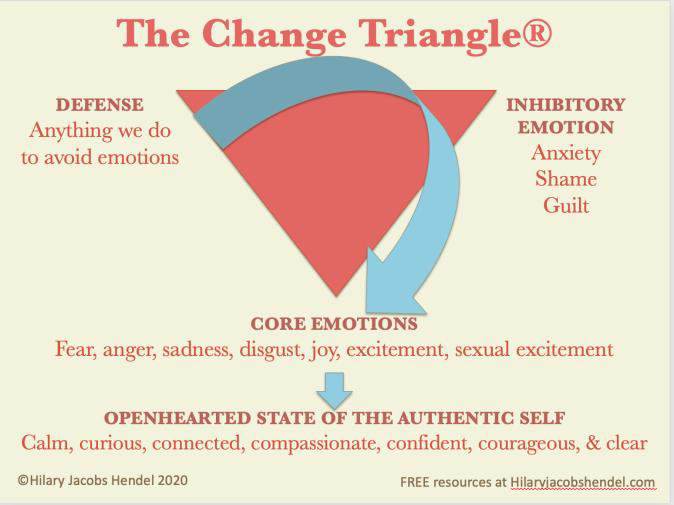
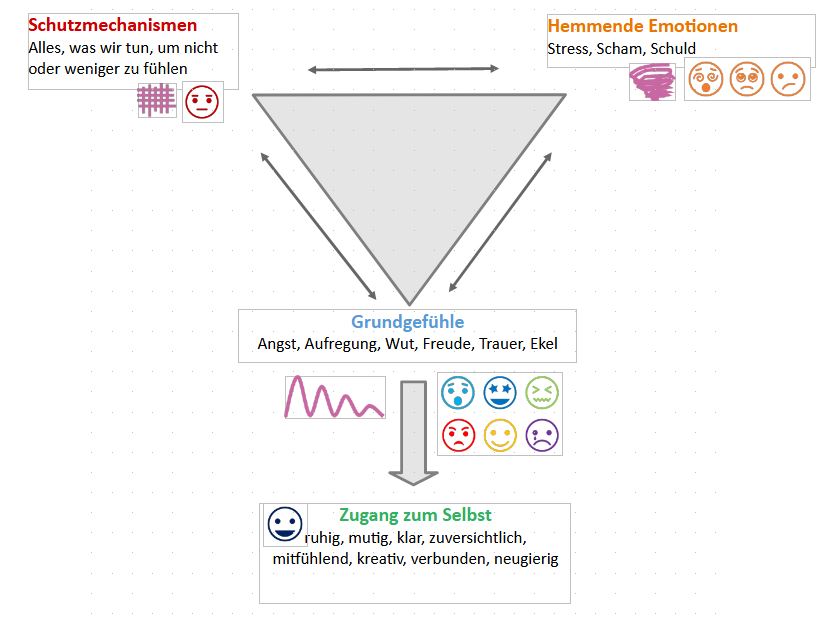
    Imagine a tool that acts as a map to help you explore your emotional landscape: it helps you categorise, understand and experience your emotions, and guides you back to your true self. This tool is the Triangle of Change.


    “If you can stay calm in the face of bad news; if you keep your cool even in the midst of a financial crisis; if you see your neighbours going on holiday to fantastic places without feeling the slightest twinge of envy; if you happily eat everything on your plate; if you can fall asleep after an exhausting day without alcohol or sleeping pills; if you always find contentment wherever you are – then you’re probably a dog.”

    – Jack Kornfield


    The Triangle of Change is your compass to help you find your way through the complexity of your feelings. It shows you where you currently stand in your emotional journey:

    • that you withdraw into yourself to protect yourself from your feelings,
    • whether you are held captive by paralysing emotions such as fear, shame or guilt
    • or whether you are in touch with your core emotions – such as joy, anger, sadness, fear, disgust or excitement – which lead you to your true self.

    The version of the Change Triangle® discussed here was introduced by the American psychotherapist and author Hilary Jacobs Hendel in her book *It’s Not Always Depression: A New Theory of Listening to Your Body, Discovering Core Emotions, and Reconnecting with Your Authentic Self* (2018). It is a simplified version of a clinical model derived from AEDP (Accelerated Experiential Dynamic Psychotherapy) – a psychotherapeutic approach developed over more than two decades by the psychologist and psychotherapist Diana Fosha and her institute in New York.

    The benefits of the Change Triangle®

    As a therapist and as a human being, I find this model very relevant, as it strikes me as profoundly human. It clearly shows that self-regulation does not mean indifference. By definition, we cannot spend our entire lives in a state of authentic self. We cannot escape chaos. As Kristin Neff says: we can only aspire to become benevolent chaos. What happens around us influences us. Life is constantly throwing things at us.

    Self-regulation is a dynamic journey. It is not some untouchable state. On the contrary: self-regulation is the ability to stay connected to oneself amidst the discomfort caused by emotions – the ability to be present in what is intense, turbulent or chaotic. And it is also the ability to recognise when we need others to support us on this journey. Regulation is precisely this movement up or down within the triangle. Defence mechanisms also have a regulatory function, even if they come at a high cost in the long term. Calm, serenity and inner harmony can be the result of regulation.

    The ability to identify where we stand on the triangle and to know how to move up or down between the three vertices and the four states helps us to manage our personal experiences. If I know where I stand, I can be depressed yet stable, I can be overwhelmed yet stable, I can be angry, excited, sad… and still stable.

    The other benefits of this job are as follows:

    • Gaining a better understanding of your feelings and making sense of them
    • Being able to put our feelings into words the very moment we feel them 
    • Less fear of emotions, more presence and serenity
    • Alleviate symptoms caused by repressed emotions such as fear and grief
    • to have more control over your unconscious behavioural patterns
    • Being able to feel our emotions makes us less reactive and less defensive
    • Gaining a better understanding of oneself and others by looking beyond appearances

    The ‘Change Triangle’: everything you need to know

    The Triangle of Change serves as a guide to identifying the defence mechanisms and inhibitory emotions that prevent us from connecting with our core feelings. Imagine it as an inverted triangle, pointing downwards. At each corner, moving clockwise – starting from the top left corner – you will find an emotional state: Defence (defence mechanisms), Inhibitory Emotions (inhibiting emotions) and Core Emotions (core emotions). Beneath the triangle lies the Openhearted State of the Authentic Self.

    Everything we do to avoid feeling: defence mechanisms

    Defence mechanisms are everything we do to avoid feeling certain emotions, or to dampen them. These can be thoughts or actions that distract us from the discomfort associated with these emotions. Common examples include negative thought patterns, distraction, consumption, sarcasm, depression, and so on. Sometimes we are aware of our defence mechanisms, sometimes we are not.

    They range from healthy ways of coping to destructive habits. We need them to get on with life, but if we rely on them all the time, we lose touch with our feelings and with ourselves. Ideally, we use our defence mechanisms when we need them, but not all the time.

    Suppressing one’s feelings: stress, shame and guilt

    Inhibiting emotions include stress (anxiety), shame and guilt. These are intense physical states that can block our primary emotions. The pressure exerted on emotions as they rise to the surface causes great distress. Inhibiting emotions serve to protect us from being overwhelmed by primary emotions (stress) and to help us fit in with the group (shame, guilt).

    We learn to recognise our feelings through our social experiences, especially as babies, children or teenagers. We learn which feelings are considered acceptable or unacceptable by those around us by observing the reactions of adults, and then those of our peers. And since our fundamental survival instinct is to stay connected to the people around us, a negative or positive reaction determines how we manage our feelings. For example, if, as a child, every time I was sad and cried, my parents told me to ‘think positively’, I learnt that sadness was not an acceptable feeling and that I would be better off not feeling or expressing it. Inhibitory feelings also come into play when basic emotions become too intense and our brain wants to switch them off to protect us from an emotional overload.

    Inhibiting emotions arise when we are at odds with our core feelings: we believe we are bad when we feel them, that we will be rejected if we feel them, or simply that we do not know how to feel them. This is how stress, shame and guilt connect us to our environment, yet also cut us off from ourselves. They act as emotional stop signs that spring up to block the core feelings we have been taught to regard as unacceptable. They will reappear throughout our adult lives unless we actively try to change these patterns and seek out new experiences or relearn.

    Our guiding principle: fundamental emotions

    Basic emotions are hardwired into our brains (the limbic system) and are beyond our conscious control: sadness, fear, anger, joy, excitement, disgust and sexual arousal. It is through these basic emotions that we discover ourselves and what matters to us. They tell us what we need, what is good or bad for us, what we like and what we dislike. Their function is to enable us to adapt as best we can to our environment, and they are always accompanied by an impulse to act. For example, anger prompts us to set a boundary when someone has treated us in a way we do not like, and fear can alert us to the fact that a situation might be dangerous.

    Each core emotion has its own energy and feels different. All core emotions exist on a spectrum and can range from mild to intense, or even overwhelming experiences. Our ability to feel and experience our emotions, as well as to ground ourselves emotionally, depends on how we were emotionally supported when we were young. We learn to self-regulate through our relationships with the people we grow up with. We need others to be able to regulate ourselves (co-regulation). Even as adults, we still need others to be able to experience and accept our feelings, even if society tells us otherwise.

    Often, we haven’t been taught how to feel our emotions. Immersing oneself in a core emotion is like riding a wave. We feel the sensations rising within us and let them be, until they subside. Core emotions need to be felt fully and acknowledged. We need our body and our breath to stay grounded in this emotional experience and stay with these sensations until they reach their peak, then fade away like a wave. When we are able to work through a fundamental emotion, we often feel a sense of relief or clarity.

    Being who we are: the self

    The authenticity of our inner self refers to our very essence and the state we experience when we feel in tune with ourselves: calm, curious, connected, compassionate, confident, courageous, clear-headed and creative. This state sets in as soon as we have fully experienced our core emotions. In this state, we often have a clearer vision of how we wish to approach a situation. The situation may not be resolved, but the pain and unease, the pressure and urgency we felt have disappeared, and we can move forward from a place of calm. The seven adjectives (in English, the seven Cs: calm, curious, connected, compassionate, confident, courageous, clear – here supplemented by creative) are borrowed from the self-description derived from Richard Schwartz’s IFS (Internal Family Systems) therapy.

    How do you use the ‘Change Triangle’?

    The Triangle of Change is a bit like a map that shows us where we are in our journey at any given moment. We can learn to find our bearings on this map and look after ourselves, because we allow ourselves to feel what we’re feeling.

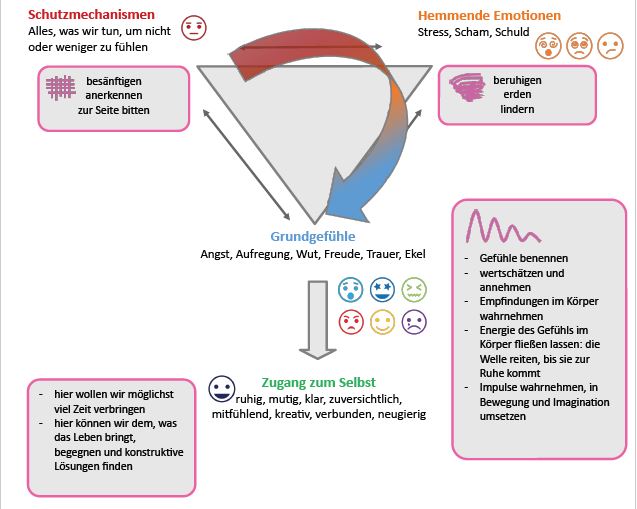
    We can approach defensive attitudes with gratitude, compassion or respectful detachment; we can soothe and ease the feelings that are holding us back, so that the underlying conflicts, needs and core emotions can come to the surface. We can learn to feel these core emotions and their waves, and to stay in touch with them until they subside and we regain our calm. We are then reconnected with ourselves and have access to our inner resources. In this state, we can cope with whatever life throws at us and find constructive solutions for ourselves.

    So, in practical terms, what can we do at the different points of the triangle of change?

    weaken the body’s defences

    When it comes to defence mechanisms, it is about recognising that we are protecting ourselves from emotional pain or discomfort. By becoming aware of our defence mechanisms, we can turn our attention inwards and ask ourselves: ‘What is going on inside me that I don’t want to feel right now? ’ Above all, it is about cultivating a compassionate attitude towards our defence mechanisms. It is understandable that we often simply want to get rid of them, as they are so unpleasant. But it is often not as simple or one-dimensional as that. Defence mechanisms do us a great service and only want what’s best for us. It is therefore important to develop an understanding of them, to recognise and value them, whilst learning and making possible other ways of managing our emotions.

    Relieve stress, ease feelings of shame and guilt

    In the section on inhibiting emotions, the aim is to become aware of the physical sensations that accompany stress (anxiety), guilt and shame. By focusing our attention on our bodies, we learn to soothe these unpleasant sensations, for example through mindful breathing, movement or mindful attention, so that the underlying blocked feelings can rise to the surface. Here again, the aim is to adopt a caring and compassionate attitude, and to understand the origin and workings of these feelings.

    Learning to ride the waves of deep emotions

    In the realm of core emotions, the aim is to perceive and experience the physical sensations associated with emotions. In this way, each emotion can become rooted in our physical experience. In a second step, we can acknowledge these emotions by naming them and allowing space to experience their ebb and flow. An emotion rises within us, then subsides. Within this movement, we also perceive the messages and impulses for action inherent in these emotions. Sometimes, we are unsure of what we are feeling; using the Triangle of Change, we can ‘try out’ different emotions by asking ourselves: am I feeling sad? Am I feeling anxious? Etc. Sometimes, we also feel several emotions at the same time. Experiencing these fundamental emotions ultimately reconnects us with our authentic self.

    The embodied state of the authentic self

    When we are in this state of openness to our authentic self, the important thing is to stay there for as long as possible and as often as possible. It is from this place that we can face life’s challenges with courage, curiosity, calm, clarity, compassion, confidence and a sense of belonging to ourselves and to the world. This is how we can deal with what is. Step by step. Our authentic self and its qualities are part of our very essence and are always there for us. We can learn to actively connect with them again and again, by making space for our feelings and for what moves us. This journey towards oneself is an art of living.

    Summary

    The Triangle of Change is not merely a theoretical concept that describes our emotional experiences and their transformative power, but also a practical tool that helps us navigate the complex landscape of our emotions in our daily lives. By familiarising ourselves with the vertices of the triangle, we learn to pay attention to our inner experience and to explore our defence mechanisms, our inhibiting feelings and our core feelings. This self-awareness and self-compassion lead us towards our authentic self, time and again, breath by breath and step by step.

    Sources and references

    Emotions Education 101™ is a registered trademark of Hilary Jacobs Hendel and Heather Sanford. Copyright Hilary Jacobs Hendel and Heather Sanford. All rights reserved. The Change Triangle® is a registered trademark of Hilary Jacobs Hendel and ‘It’s Not Always Depression©’ is a registered trademark of Change Triangle LLC.

    Hilary Jacobs Hendel, It’s Not Always Depression: A New Way to Listen to Your Body, Understand Your Deepest Emotions and Reconnect with Your True Self, 2018

    Hilary Jacobs Hendel also offers a wealth of resources on the ‘Change Triangle’ and emotions on her website HERE

    Diana Fosha, The Transformative Power of Affect: A Model for Accelerated Change, 2000

    Diana Fosha (ed.), Undoing Aloneness & the Transformation of Suffering into Flourishing: AEDP 2.0, 2021

    To find out more about AEDP (Accelerated Experiential Dynamic Psychotherapy), click HERE

    Richard C. Schwartz, Introduction to the Internal Family System, 2001

  • From the body work to body therapy, from the Grinberg Method to AEDP

    From the body work to body therapy, from the Grinberg Method to AEDP

    “Our bodies are not things we have—they are what we are.”

    When I first started working with the Grinberg Method over 15 years ago, I was deeply impressed by the clarity and intensity with which this bodywork brought people back to their own perception. The idea that our bodies store patterns we can learn to interrupt struck me as not only powerful but profoundly emancipatory. And indeed, many people found access to themselves through this work, breaking free from old automatisms and discovering new scope for action.

    But over time, I also became aware of its limitations. And not just that—I began to critically question aspects of the method.

    Individualization of Suffering

    Time and again, I encountered an implicit narrative in the work: “If you understand and interrupt your pattern, things will get better.” But what if the suffering doesn’t stem from an individual pattern at all? What if it comes from structural violence, trauma, or systemic disadvantage? I started to realize that the Grinberg Method left little room for these larger contexts. Suffering became something to be overcome through one’s own behavior. This can be empowering—but it can also isolate and alienate.

    Self-Responsibility to the Point of Self-Blame

    What I once perceived as self-empowerment increasingly felt like a burden I was unknowingly passing on to my clients. If something didn’t improve, the conclusion was often: You haven’t stopped your pattern enough. You’re making yourself a victim of your patterns. You lack discipline. An unspoken but pervasive idea of self-blame began to take hold.

    The Body as an Object

    In Grinberg work, the body is trained, controlled, and influenced. Even when the focus is on perception, there’s often an underlying goal: to get better, to become freer, to be more relaxed. I began to notice how this could foster an instrumentalizing attitude toward one’s own body—not a loving relationship with it, but a functional optimization.

    Lack of Trauma-Sensitive Foundations

    Many people who came to me carried deep wounds. Direct, body-focused work wasn’t always helpful for them. In some cases, it was overwhelming. I searched for an approach that worked not only with the body but also with inner safety, affect regulation, and attachment. And I found: AEDP.

    AEDP—A New Relationship to Experience

    In AEDP (Accelerated Experiential Dynamic Psychotherapy), the focus isn’t on eliminating symptoms. Instead, it’s about slowing down, bearing witness, and holding the experience together. Pain is allowed to exist. It isn’t judged or analyzed as a pattern. It’s brought into relationship. And this is exactly what I felt was missing in the Grinberg Method: the compassionate, regulating relationship. I’m not an expert about you. I’m with you. This has deeply transformed my own work.

    Ethical and Structural Clarity

    AEDP is a scientifically grounded psychotherapeutic approach with clear ethical guidelines, supervision, reflection, and language. In the Grinberg Method, such frameworks were either absent or, in my training, shaped by structures that raised significant red flags regarding power, control, and transparency. Much was left to the individual discretion of teachers, trainers, and practitioners. In work that goes so deep, this can be boundary-crossing. This, too, became increasingly clear to me.

    What Remains?

    I’m grateful for the years I spent with the Grinberg Method. It teached me how to accompany emotional processes through touch. It gave me a language for embodiment that no one can take away from me. But my path has led me further. Today, I work with AEDP, using a trauma-sensitive, relationship-based, and deeply human approach. If it feels right and meaningful for my clients, I also incorporate direct touch within this framework.

    (The focus on interrupting bodily patterns by influencing breath, movement, and perception is central to body-oriented coaching, but not to therapeutic work.)

    And if you, as a client, are reading these lines: You are allowed to feel seen in everything you bring with you. Not just in your patterns, but in your story, your pain, and your hope. I’m happy to accompany you—not as someone who knows what you need, but as someone who listens alongside you.

    If you want to know more about AEDP, you can start here.

    If you want to know more about the Grinberg methode, start here.

    Avi Grinberg, Becoming Yourself: Body Attention and the Fulfillment of Potential, 2021

  • How Long Does Grief Last? The 6 Needs of Mourning

    How Long Does Grief Last? The 6 Needs of Mourning

    This text was originally published in English on the It’s Complicated blog.

    “Grief is what you think and feel on the inside after someone you love dies. Mourning is the outward expression of those thoughts and feelings. To mourn is to be an active participant in our grief journeys. We all grieve when someone we love dies, but if we are to heal, we must also mourn.” – Alan D. Wolfelt

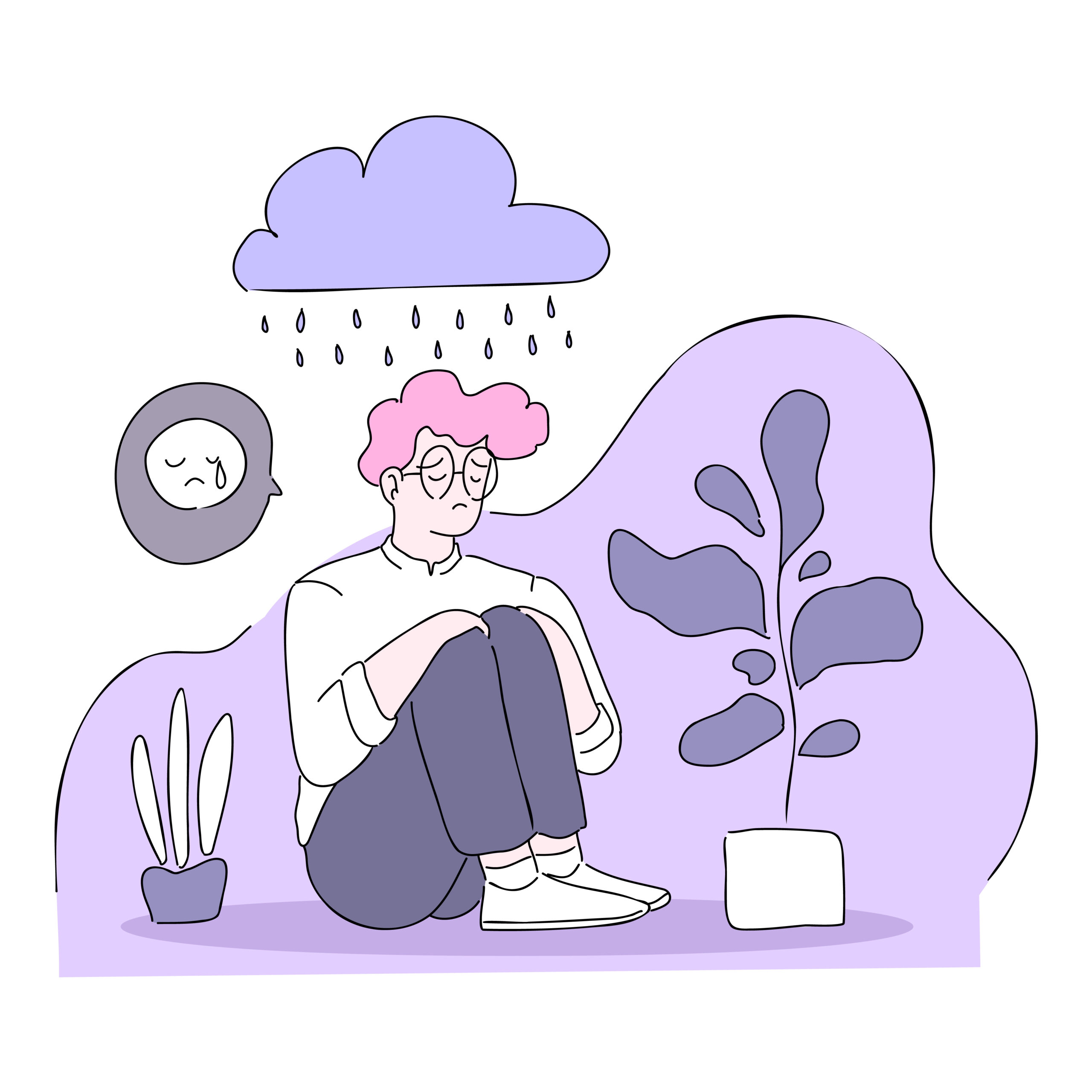
    “Is it still normal that I am so sad? Am I overreacting? How long will it last?” A lot of people are very skeptical of how – how often, how long, how intense – their sadness shows up. No matter if they have every reason to feel sad. They may have experienced the death of a child or a parent, divorce, a breakup, a decline in health, the loss of their home, their health, their workplace or children leaving home… and still they will argue: “I don’t want to cry anymore. I’ve cried enough.” or, “Why should I cry at all? It doesn’t feel good, and it doesn’t help.” In this post you will learn why and how engaging actively in your sadness is key to healing.

    Understanding Grief

    Loss fundamentally changes our lives. Some losses create a distinct “before” and “after”. The transition from one to the other is a long and painful process. Grief is challenging, exhausting, and demands time, energy, and space. Grief and sadness are natural reactions to loss, but often, we haven’t been taught how to be sad or how to grieve.

    Did you witness your parents crying? Did you attend funerals as a child? Did you observe someone mourn and gradually recover? How did the adults around you discuss death and loss? What did their actions teach you about handling such situations?

    Grief is the individual journey of mourning, and while our culture has established rituals for death, there are few for other types of loss. Mourning can serve as the process through which we determine the rituals necessary for our unique healing.

    Common Misconceptions About Grief

    Grief is not a mental illness, even though it can be intense and enduring. On the contrary, suppressing grief and sadness can lead to issues like depression or psychosomatic symptoms. Seeking assistance from a counselor or therapist during grieving can prevent these problems and provide support in a culture that often struggles to accommodate sadness.

    Grief is not a ‘to-do’ you can just get over with. It is a journey, and some grief may persist for a lifetime. Pain is an inherent part of life, just like joy, excitement, laughter, and happiness. We cannot selectively numb our feelings; rejecting sadness also diminishes our ability to feel happiness, joy, and gratitude. All emotions then become shallow.

    While grief is often portrayed as progressing through stages (e.g. denial, anger, bargaining, depression, acceptance), for some those models are too rigid and limiting. Stages seem to imply a clear beginning and ending, which can lead to feelings of shame and guilt or make you feel as if you are doing something wrong. And this is the last thing you need when you are grieving.

    Embracing the duration and movements of the grieving process can be challenging. Some may find it difficult to accept moments of feeling better, fearing that it minimizes their loss, while others struggle to accept another wave of sadness, fearing they will be inconsolable. The model of the six needs of mourning by Alan D. Wolfelt might be a helpful path to healing.

    “Some things cannot be fixed. They can only be carried.” — Megan Devine

    The Six Needs of Mourning

    Wolfelt describes six needs of mourning as the tasks life presents to us after loss. Actively addressing these needs constitutes mourning. There is no specific order and it’s normal to move between them. Each need may require your attention again and again for months. Be patient and compassionate with yourself as you work through them.

    1. Acknowledge the reality of the loss.

    After a loss, accepting the new reality that someone or something you cared deeply about will never physically return to your life is immensely challenging. At times, you may deny this reality in order to cope. In the traditional stages model, acceptance is the ultimate goal, but sometimes you can’t accept it. In this case it’s enough to acknowledge the loss. Revisiting memories around the loss and sharing them again and again is a crucial part of mourning; each time you speak about it, the loss becomes a bit more real.

    2. Embrace the pain of the loss.

    This one doesn’t come naturally. It’s easier to avoid, suppress, or deny our pain, especially since our culture often encourages this behavior and praises those who stay “strong” and “in control.” Expressing feelings of sadness or grief is often met with the advice to “move on,” “be grateful,” or the belief that “everything serves a purpose.” When confronting your pain, you may need to adjust how much you can handle at once. Your pain must learn to manifest itself in ways you can tolerate, as you need to learn to tolerate your pain. There will be moments when you need to move away from it and others when you need to create a safe space for meeting it.

    3. Remember what has been lost.

    This one is about the love that exists in grief. Create your own personal rituals to maintain your connection with what you’ve lost. Keeping your memories close can help you become hopeful and open to new things down the road. Just as courage is the flip side of fear, love is the flip side of grief. It’s not about letting go but rather about finding another place for what was lost within you and in your life.

    4. Develop a new self-identity.

    Grief can be like a magnifying glass, revealing what truly matters to us. When you lose someone or something that was part of you and your life, the way you perceive yourself naturally changes. The deeper your connection to what you lost was, the more profound the transformation may be. You’ll transition from “wife” to “widow,” “parent” to “bereaved parent,” “married” to “divorced.” Although this shift can be draining, frightening, or frustrating, you’ll gradually grow into it. Along the way, you’ll discover new facets of yourself: renewed confidence, tenderness, kindness, and even assertiveness.

    5. Search for meaning.

    “Why did this happen to me?” Don’t get stressed! You may or may not find an answer to this question. Loss reminds us of our lack of control, and feelings of helplessness, sadness, and loneliness can be overwhelming at times. However, you will eventually find your way and live into answers that provide meaning in your personal journey of loss.

    6. Receive ongoing support from others.

    We’re not meant to go through tough times all by ourselves. How much you reach out for and accept help from others during your grieving journey has a big impact on your ability to heal. It’s important to understand that seeking support from friends, family, or professional counselors isn’t a sign of weakness, it shows how much you care about what you’ve lost. In a society that often rushes past sadness, there might be expectations for you to quickly “move on,” but it’s essential to communicate with those around you about what kind of support you need. This can sometimes feel like too big of a  task. Since grief is a lifelong process, getting support remains important for months and even years after your loss. 

    Conclusion

    Grief is a natural response to loss, and mourning is the active process that helps us address our pain and heal. Understanding and embracing the six needs of mourning can guide you towards reconciling with your grief and integrating the new reality of living without what was lost. In doing so, you can make room for hope in your future and regain the energy to engage fully in the activities of your life.

    A Journal Prompt for Grief

    Take a piece of paper and draw six circles, one for each of your own needs. Write down what you have already done to take care of each of these needs. Take a moment to think about additional things you’d like to try. Consider which need has been particularly tough for you to deal with and think about what might assist you in addressing it. 

    Keep in mind that these needs can change over time, and you may find some aspects more challenging as you go through your grieving process. Trust that you’ll be able to address each need in your own time, and be kind to yourself as you navigate the ups and downs of grief and healing. You may also take a look at these tips on practicing self-compassion.

    Sources and resources:

    Alan D. Wolfelt, Understanding your grief. Ten Essential Touchstones for Finding Hope and Healing Your Heart, 2021 (1992)

    Megan Devine, It’s Ok That You’re Not Ok: Meeting Grief and Loss in a Culture That Doesn’t Understand, 2017

    George Bonanno, The Other Side of Sadness: What the New Science of Bereavement Tells Us About Life After a Loss, 2019 (2009)

    Watch How to help a grieving friend HERE

    Grief journals:

    Alan D. Wolfelt, The Understanding Your Grief Journal: Exploring the Ten Essential Touchstones, 2021

    Megan Devine, How to Carry what can’t be fixed. A Journal for Grief, 2021

    Podcasts:

    English: Megan Devine, It’s OK That You Are Not OK
    German: Christine Kempkes, Liebevoll Trauern

    You may also want to look out for online support groups or writing groups HERE.

    For Germany, take a look HERE.

  • How to Establish and Sustain Healthy Boundaries

    How to Establish and Sustain Healthy Boundaries

    This text was originally published in English on the It’s Complicated blog.

    Personal boundaries are all about creating space for yourself, about you feeling protected and safe in this world and in your relationships. They clarify your needs and expectations, and let you know when to say no and when to say yes.

    In this post, we will look at the essential aspects of being boundaried: noticing, communicating, and holding personal boundaries. Before we do that, let’s first define what personal boundaries are.

    Understanding Personal Boundaries

    Personal boundaries are a psychological process that allows you to protect yourself from the world and contain your emotional complexities. Boundaries shape your sense of self. They can be categorized into two types: protective and containing boundaries.

    Protective Boundaries: Protective boundaries are the external boundaries we establish to communicate our needs and expectations to others. They create a safe and structured environment around us. These boundaries help us protect our space, time, and energy, and they often involve saying “no” when necessary. 

    Containing Boundaries: Containing boundaries are the internal boundaries we establish to define what we need and expect of ourselves in relation to others and within our own inner world. These boundaries create a sense of safety and structure within ourselves. Containing boundaries involve saying “no” to behaviors or tendencies that may be harmful or counterproductive. They help us maintain self-control and emotional regulation.

    So far, so good. However…

    Boundaries in a culture of control

    Our culture tends to view boundaries through the lens of control, often emphasizing rules, power dynamics, and punishment. The focus is on standing firm and not allowing any breaches. We are advised to set consequences for ourselves and others: “If you do this, I will do that.” When someone tells us, “You really need better boundaries,” it often translates to, “You should be able to change the other person’s behavior.”

    But here’s the crucial distinction: boundaries are not about dictating to others what they should or shouldn’t do; it is not their responsibility to listen to your boundaries. Their job is to live their lives. To effectively protect ourselves we can’t focus on the results in the other person. Protecting means creating a space so you can reach a place of safety. 

    Similarly, when it comes to containing boundaries, if we fixate on outcomes, we enter a power struggle within ourselves. It is the double bind of our culture regarding boundaries: either we’re encouraged to protect them through power and control, or we’re pushed to constantly expand them, expected to do and be more.

    Whether it’s about protective or containing boundaries, the message is: “You need to be tough.” This has been a generational conviction, fostering an open door to toxic shame and guilt. However, we don’t need to establish boundaries—they already exist. What we need to do is notice and communicate them. Being boundaried means to openly acknowledge that we all have limits in terms of what we want and can take and give. 

    Especially in close relationships, it requires patience and an awareness of both our own boundaries and those of the other person in order to create a space where both feel safe and respected. Unfortunately, we lack role models for this, having no idea what connected, loving, AND assertive boundaries truly look like. But we can create space and explore.

    Journal Prompt: Exploring Your Own Boundaries
    Think of the last time you communicated a boundary with someone:

    1. How did you become aware of your boundary? Describe the thoughts, feelings, and sensations that made you aware of it. What was your inner response to it?

    2. How did you share the boundary with the other person? Could you be clear and direct, or did you communicate it differently? How did sharing your boundary make you feel?

    3. How did the other person respond to your boundary? What was it like for you to face their response? What did you need to maintain your boundary and stand up for yourself? How did you support yourself in doing so?


    1. Noticing Personal Boundaries

    We become aware of personal boundaries in social contexts and interactions. To notice our boundaries, we need to be connected to our emotions, receiving their messages and action tendencies, whether it’s anger, fear, disgust, excitement, joy, or love.

    Here are some examples of what you might experience when encountering your boundaries:

    • Feeling annoyed or angry: Anger signals that something is not ok for you and provides the energy to protect yourself. Suppressing anger often diminishes its protective function, leaving you feeling bitter and resentful.
    • Feel anxious: Anxiety indicates underlying feelings, needs, or conflicts. Calming anxiety allows you to uncover those, whether it’s uncomfortable or mixed emotions, unmet needs, or unresolved conflicts.
    • Feeling guilty or obligated: There’s no such thing as guilt-free boundaries. Many of us were raised to believe that putting our needs first or having desires was wrong, instead, we were often responsible for fulfilling those of others.
    • Feeling overwhelmed and overloaded: Experiences of exhaustion and inner emptiness are very common, often resulting from the pressure to constantly achieve more. Demonstrating these boundaries requires courage, and it is life-saving.
    • Feeling uncomfortable: You may simply sense discomfort or unease and have an inner discussion whether something is still acceptable, valid, or relevant to you. Congratulations! This kind of inner dialogue means you met your boundary. It’s a good moment to get to know them!

    Experiential Movement: Making Space for Yourself
    To get a felt sense of making space for yourself, choose a song that ignites feelings of fierceness, clarity, courage, or empowerment in you. Stand comfortably, close your eyes, take a few deep breaths, and recall a situation where you needed to communicate a boundary. If possible, express it in a single sentence (e.g., “I want,” “I need,” “I expect,” “I say no to…”). You can also say it out loud. How does it sound? What’s it like to hear it?

    Then, play your chosen song and let yourself move freely. Find movements that feel expansive and liberating. Explore how your body wants to move, whether it involves stretching, shaking, or any other movements feel spacious.

    After the song ends, pay attention to how you feel in your body and to your emotions. You can repeat your boundary sentence and observe if it has shifted. What’s it like to say and hear it now?

    Whenever you recognize your boundary, take time to clarify what it’s safeguarding and understand its protective role: your time, your energy, your money, your stuff, your body, your integrity, your emotions, your peace of mind… You have the choice to stop or go beyond it. There is no right or wrong in this; the key is to be aware of your decisions and motivations.

    • When You Choose to Stop: What’s it like for you when you decide to stop at a point where something within you signals: “This is enough”. What do you require to stop? Do you need encouragement, additional self-care?
    • When You Choose to Go Beyond: What’s it like when you decide to push beyond your boundaries? What does this experience entail for you? What resources, like a break or additional support, do you need afterward?

    It’s essential to fully acknowledge your responsibility in choosing to stop or expand your boundaries. Protecting as well as expanding can provide a deep sense of personal freedom, and both can be emotionally challenging.

    I DON’T HAVE TIME TO STOP! I hear you, if that is your truth. Maybe you’re working in health care, caregiving for a family member, delivering other services or whatever else your good reason might be. Take one minute. Close your eyes. Stop. Feel your feet on the ground. Take a deep breath. Notice for yourself: I am here. Right now. This is my truth. It’s a hard thing to remember. I know. I also forget. Still, it’s worth trying if you can. Once, a surgeon told me after a session: “I will be the first doctor that is actually breathing during morning rounds.” May you be the first in yours!


    2. Communicating Boundaries

    Expressing your boundaries to others can take various forms. Some days, putting your children in front of the TV might be an expression of a boundary (your need for a moment of solitude to eat in peace, for instance), while on other days, insisting on turning off the TV might be the boundary (reflecting your expectation for shared meal times).

    Communicating boundaries is more than just marking your territory. We all coexist within one space, and on a broader scale, we’re beginning to recognize, through events like the COVID-19 pandemic, climate change, and migration, that our boundaries aren’t strictly separated territories. We often bump into each other, intentionally or not. While we don’t have control over what is happening in the world, we can influence how we engage with others and our circumstances—with power, control, and domination or with courage, kindness, and compassion.

    Effective communication of boundaries is NOT:

    • Establishing territory: We all navigate one shared space according to our needs and wants.
    • A one-time empowerment act: It requires continuous cultivation of the capacity and energy to maintain boundaries.
    • An attempt to alter someone else’s behavior: Others act according to their wants and needs.
    • A battle to win: It’s not about initiating a fight in the first place.

    Communicating boundaries IS about:

    • Creating space for yourself: Clearly and directly expressing your needs, wants, and expectations by saying things like, “I want…”, “I need…”, “I expect….” Be precise, avoid complex language, and say no when necessary.
    • Focusing on your needs: Prioritize what you need to do to ensure your safety and well-being.
    • Taking responsibility for your needs and wants: Always assume responsibility for them. They are legitimate.
    • Empowerment, even amid challenges: It involves confronting conflicts, guilt, awkwardness, and other difficult experiences.

    It’s essential to understand that you cannot control how others will react. For example, believing that if you were more assertive with a colleague, they would stop inviting you to their network events is an oversimplification. While improving your assertiveness may help, there’s a significant chance that people won’t respond with acceptance. This is normal, as they, too, are guided by their own wants and needs.

    Both boundaries and how we communicate them are flexible, subject to change in various contexts and over time. It is normal to need very rigid boundaries with certain individuals (e.g., bullies) while maintaining more open and flexible boundaries with others (e.g., trusted friends). Nonetheless, there are contextual “bottom-line positions” (Harriet Lerner)—boundaries that are non-negotiable even under relational pressure.

    There is a line between people following their needs and wants in unpleasant and hurtful ways and behaviors that are criminal, violent, abusive, or neglectful. In cases of interpersonal violence and coercive control, it’s essential to recognize that these behaviors intend to violate your boundaries and break your resistance. They are often protected by structures such as patriarchy, white supremacy, heteronormativity, capitalism, and more. Understand that you are already doing what you can to protect yourself within the given situation, and you deserve all the help and support required to protect yourself.

    If you could use some encouragement in exploring how to share a boundary, listen to Dr. Kristin Neff’s Fierce Friend.


    3. Holding Boundaries

    Maintaining your boundaries is often the most challenging aspect and requires a lot of attention and energy. Here’s what it means:

    • Facing other peoples’ protests: Be prepared to face various responses and protests from others when you communicate your boundaries. They are not used to it.
    • Facing your own discomfort: It is normal to feel uncomfortable or conflicted when you communicate your boundary. You are just not used to doing this.
    • Remaining responsible: You are responsible for your boundaries even after you’ve communicated them. It’s not about handing over control to someone else just because you’ve expressed your needs or expectations.
    • Navigating colliding boundaries: Be prepared to encounter situations where your boundaries clash with those of others or even within yourself. This can be especially challenging, and you’ll need strategies to navigate such conflicts.

    Maintaining either protective or containing boundaries may not always be equally easy. Your ability to uphold boundaries depends on various factors such as your current stress levels, personal strength, perseverance, available support, privilege, patience, and sometimes, your nerves. The more adversity you are facing in response to your boundary-communication, the more it might be exhausting to maintain them. Adapting to what is possible for you at a given moment does not make you weak or neglectful of yourself. It’s essential to recognize your efforts and be kind to yourself. Get support if you need it! 

    Possible Responses to Boundary Communication

    When you communicate your boundaries, you may encounter a range of responses from others, including:

    • Understanding and respect.
    • Repeated disregard for your boundaries.
    • Offers of alternative solutions or attempts to negotiate.
    • Ignoring your boundaries as if they didn’t exist.
    • Arguments questioning the appropriateness or motivations behind your boundaries.
    • Feelings of being attacked or punished.
    • Complete withdrawal or avoidance.

    How would you like to respond to these various reactions and what do you need to bolster your capacity to remain detached when others’ responses don’t align with your truth, are not your responsibility, or simply are hard to bear?

    Dealing with Discomfort

    Sharing boundaries can lead to discomfort within yourself. Here are some of the ways it might feel and some ideas that might help you to get through it:

    • Guilt: Many of us have learned to feel guilty for prioritizing our own needs and wants. Get curious: What would you be feeling if you wouldn’t feel guilty? Reach out for support if needed.
    • Anxiety: You may fear the worst outcome when you share boundaries. Engage in whatever helps you calm down and try to make space for what the anxiety is covering up (Mixed or strong emotions, needs, conflicts). Talk it through with someone you trust.
    • Sadness: Setting boundaries might make you feel sad for having to be “not nice”, or you may need to grieve the loss that comes with boundary-setting. What could give you comfort?
    • Remorse: You might question if you went too far, were too harsh, or said something wrong. Remember: receiving a boundary is rarely pleasant, it is ok that the other person is feeling this!
    • Awkwardness: The dynamic of the relationship may change, and you may feel uncertain about how to proceed. Take a deep breath! You just did something uncomfortable for you and the other person. It’s ok to feel this.
    • Helplessness or Frustration: You may feel like nothing you can do will change the situation. Some situations are hard to bear. What can you do to make space for yourself without having to find a solution right now?

    If you need fierce encouragement not to get defensive about your boundaries and let other people have their feelings about them, listen to and get the energy from How to state a boundary without needing to justify it.

    Colliding Boundaries

    In certain relationships or situations where leaving is not an option, such as in parenting, shared custody, job obligations, hierarchies, or caregiving, you may encounter colliding boundaries. This can happen when:

    • Your boundaries clash with another person’s boundaries, which can be especially challenging in close relationships: your partner wants a big family, you don’t. 
    • Your protective and containing boundaries conflict: you need rest and don’t want to leave colleagues unsupported.

    In these situations, making space for yourself begins with an internal act of being and staying present with yourself. It might also involve relying on the protection of your containing boundaries. This may require you to compassionately prevent yourself from reacting defensively or dismissively, both towards others and yourself.

    If you’re a caregiver or need to make space for yourself in relationships where you can’t remove yourself, listen to Dr. Kristin Neff’s Self compassion for care givers or practicing Compassion with Equanimity.

    Summary and Key Learnings 

    • Boundaries are about making space for yourself, not changing or controlling someone else’s behavior.
    • Our culture often presents a double bind about boundaries, emphasizing both toughness in protecting them and toughness in expanding them.
    • Boundaries may manifest in various ways, including through protective anger, anxiety, overwhelm, overload, and discomfort.
    • Boundaries can be protective or expansive, and understanding your reasons for each is crucial.
    • Sharing boundaries can take different forms depending on social contexts.
    • Holding boundaries means to handle responses from others and manage your own discomfort to maintain them once you share them.
    • This can be particularly challenging in close relationships and when dealing with colliding boundaries.
    • Remember: boundaries are a complex psychological process of self protection that requires courage, clarity, fierceness and compassion! Be brave and be kind, to yourself and others.

    Sources and Resources

    Nedra Glover Tawwab, Set Boundaries, Find Peace. A Guide to Reclaiming Yourself, 2021

    Mark Groves Podcast, Harriet Lerner: 7 Steps On HowTo Find Courage And Use Your Voice

    Pretty Deadly Self Defense Podcast, Susie Kalish About Winning and Losing in Self Defense

    The work of Pia Mellow

  • Mental Health Support for Expats in Berlin: Where to Find Help

    Mental Health Support for Expats in Berlin: Where to Find Help

    In my work, I support many LGBTIQ individuals from all cultures and backgrounds.

    Living abroad is exciting—but it can also be an enormous psychological burden. Whether it’s homesickness, language barriers, cultural differences, or simply the stress of navigating a new system, your mental health deserves attention. Fortunately, Berlin offers numerous resources to help you, from therapy options and crisis hotlines to online tools.

    In this article, you’ll find a comprehensive collection of contacts, websites, apps, and emergency resources.

    Therapy Through Public Health Insurance

    My services primarily cater to self-paying clients. However, private health insurance or supplementary insurance for Heilpraktiker (alternative practitioners) often partially reimburse the costs for psychotherapeutic services. Billing is based on the Gebührenordnung für Heilpraktiker (GebüH – 19.2 Psychotherapy). For long-term therapeutic support, investing in supplementary Heilpraktiker insurance is highly recommended.

    In Germany, you can access psychotherapy or psychiatric treatment through your public health insurance (GKV). Here are the key steps and resources:

    1. Finding a Therapist

    • Through your general practitioner (GP) or health insurance:
      Your GP or health insurance provider can help you find a therapist. Many insurance companies also offer their own referral services.
    • Online search:
      Use platforms like:
      • Psych-Info.de – Official database of the Federal Chamber of Psychotherapists.
      • Arztsuche 116117 – Search for psychotherapists and psychiatrists in your area.

    2. No Available Spot? Private Therapy Covered by Public Insurance

    If you can’t find a therapist who speaks your language or is accepting new patients, you can apply to have your public insurance cover a private therapist.

    3. Additional Therapy Referral Services

    • Therapie.de – Aggregates therapists who treat both publicly and privately insured patients. Note: Both groups are mixed here—filter by your insurance type!
    • It’s Complicated – Platform for multilingual therapy in Berlin (including online sessions).

    Free Hotlines and Emergency Resources

    If you’re in an acute crisis or just need someone to talk to, there are 24/7 hotlines and services available—many in English or other languages.

    Emergency Situations

    • Emergency number 112 – Call immediately in cases of self-harm or harm to others!

    Crisis Services in Berlin

    Suizid Prävention

    Berliner Fachstelle Suizidprävention: Multilingual support for clients and relatives of people with acute suicidal tendencies.

    Help for victims of crime and violence

    Berlin Help portal for victims of crime

    Telephone Counseling & Support

    • TelefonSeelsorge – Free, anonymous counseling:
      • English: 030-44 01 06 07 (daily, 6 PM–midnight)
      • German: 0800-111 0 222 (24/7)
      • Russian: 030-44 01 06 06 (24/7)
        The counselors assist with psychological issues, refer you to specialists, and help with concrete problems (e.g., family conflicts or finding English-speaking doctors).
    • 7 Cups – Free 24/7 chat with trained volunteers (not therapists, but good listeners).
    • soulspace – Free in-person or phone counseling for young people aged 15–35.
    • TK-Ärztezentrum (for TK insurance holders only):
      • 040-46 06 61 91 00 – Available 24/7, 365 days a year for medical advice.

    Support for Queer People

    Lesbenberatung Berlin: Multilingual Counseling and support for lesbians, bisexual women, trans, intersex, non-binary, and queer people in crisis situations and on various topics.

    TransInterQueer e.V.: Multilingual psychosocial and professional counseling, group meetings, training and continuing education, as well as leisure and support services by and for trans, intersex, and non-binary individuals.

    Queermed: Queermed offers a Germany-wide directory of sensitised doctors, therapists and practices as well as workshops and lectures.

    Schwulenberatung Berlin: Counseling on health, drugs and alcohol, aging, identity and coming out, social law, anti-discrimination, and homelessness for gay or bisexual men, lesbian women, and trans or intersex individuals. For example you find here information about Transitioning in Berlin.

    LesMigras: The anti-violence and anti-discrimination department of Lesbenberatung Berlin e.V. It provides specialized counseling on violence, discrimination, flight, and asylum for lesbians, bisexual women, trans, intersex, non-binary, and queer people—with or without experiences of racism or forced migration.

    L-Support Helpline: Offers support for lesbophobic and queerphobic violence. Available Saturdays, Sundays, and holidays from 5 PM to 9 PM at +49 30 459 618 65.

    GLADT e.V.: Multilingual, low-threshold counseling services for Black people and People of Color, lesbians, gays, bisexuals, trans, intersex, and queer people.

    Additional Support Services

    Why Is This Important?

    Many people hesitate to seek help—whether out of shame, uncertainty, or the belief that their problems “aren’t serious enough.” But mental health isn’t a luxury; it’s a fundamental requirement for a fulfilling life. Whether you feel overwhelmed, anxious, or just need someone to talk to—you are not alone.

    Berlin has a large international community, and many people are going through similar experiences. Don’t hesitate to seek support—your well-being is worth it.